AI Agents for US Customer Support Teams: What Works and What Stays Human
AI Agents9 min readNovember 22, 2026

AI Agents for US Customer Support Teams: What Works and What Stays Human

AI agents suit the repeatable part of a US support queue, provided customers can still reach a person. What the job data and customer surveys say, which contacts to automate first and the rules to design for.

Should a US customer support team use AI agents?

Yes, for repeat questions with documented answers, as long as customers can reach a person quickly. In a Gartner survey from December 2023, 64% of customers said they would prefer companies not use AI in service, and their top worry was losing access to a human. Start with a few contact reasons, disclose the AI, hand off with the full history and measure resolution against your human baseline.

01

The short answer: automate the repeat questions and keep a person one step away

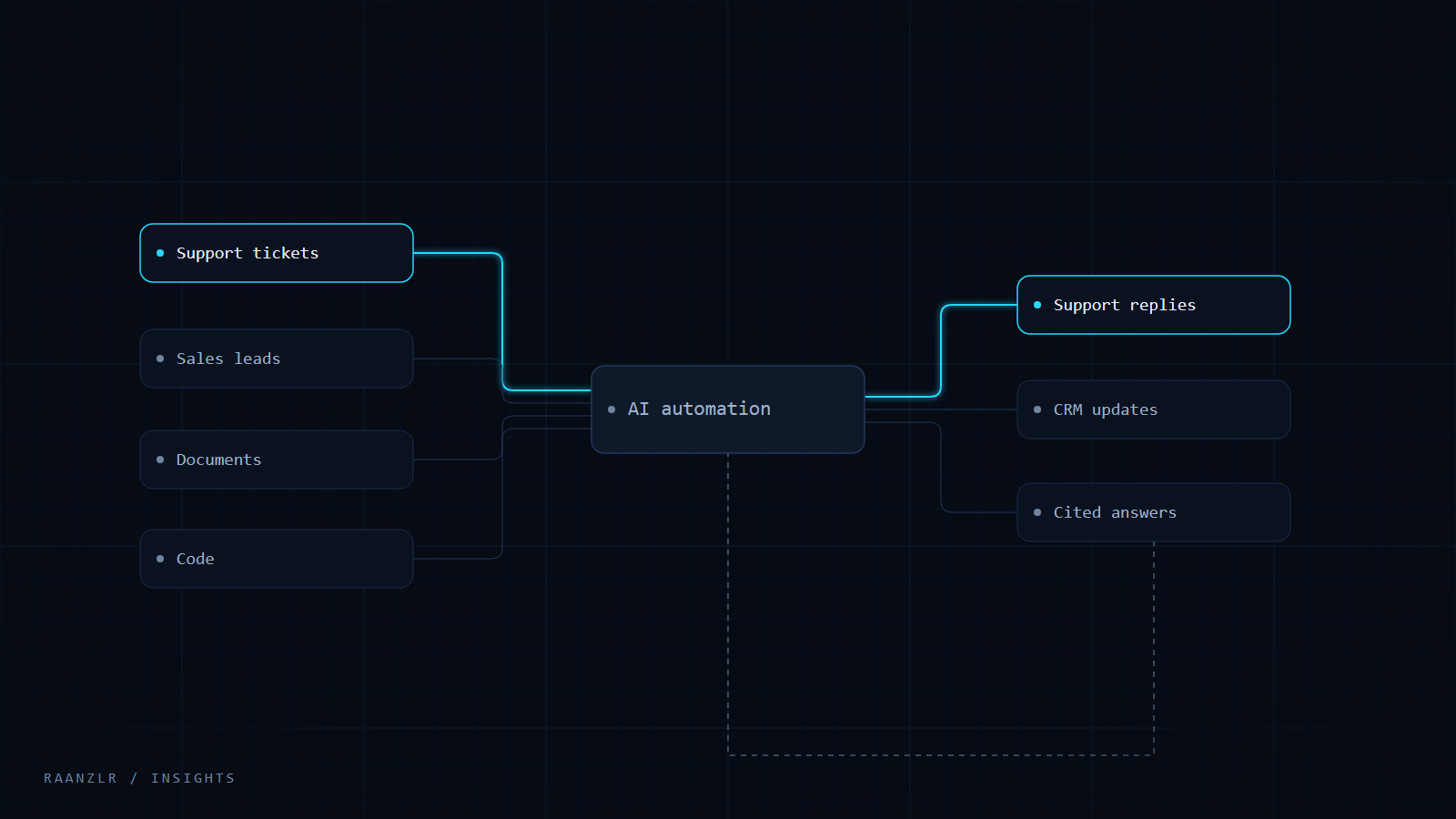
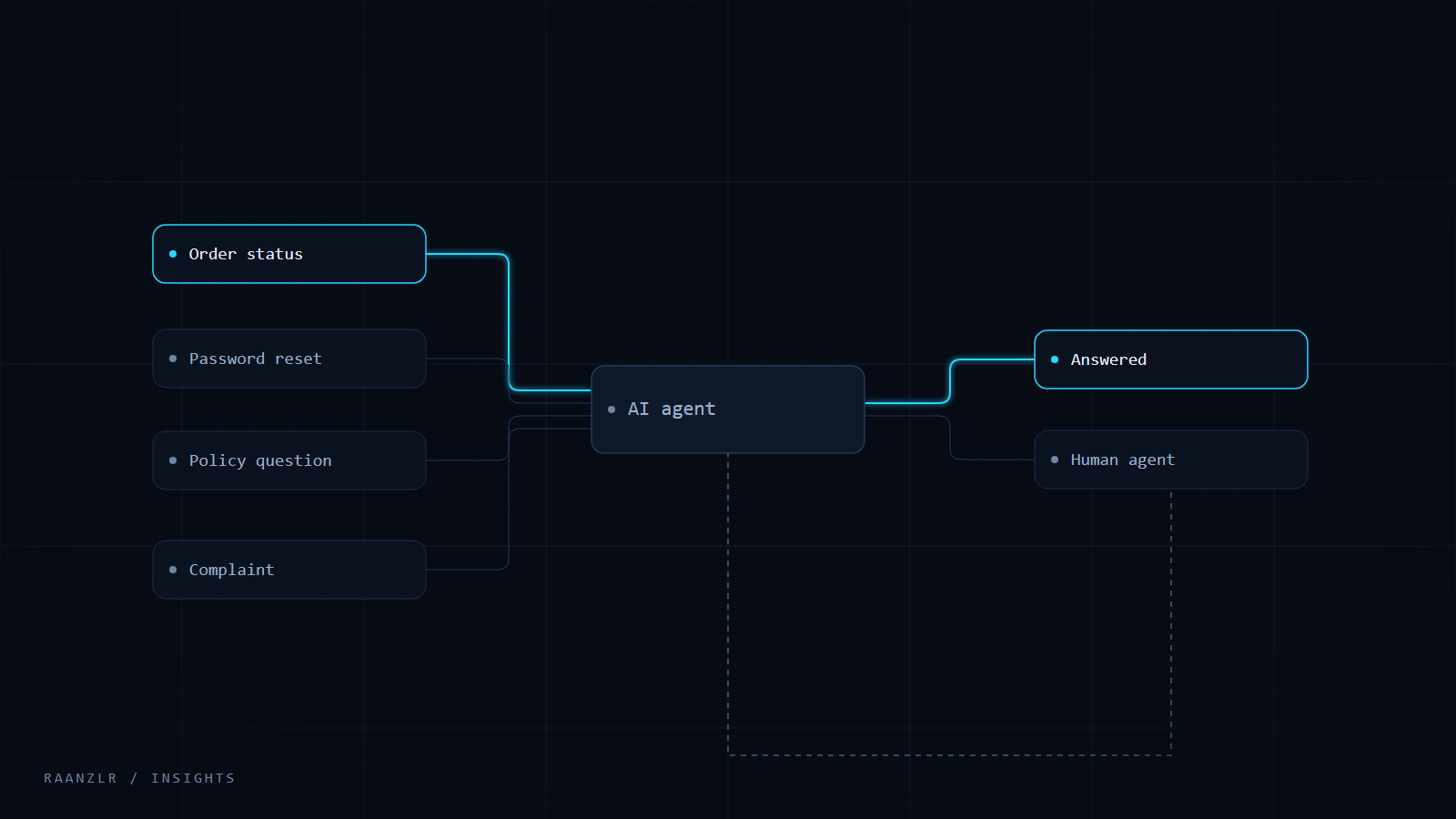
AI agents are worth using in a US support team for the repeatable part of the queue: order status, password resets, policy questions, appointment changes. They work when the agent answers from your own documentation and systems, and when a customer can reach a person in one step. Teams that use them to make people unreachable risk losing customers and, in a growing number of states, run into the law.

The technology has improved quickly, but the evidence on staffing and customer trust is more cautious than most vendor pages suggest. This guide looks at what the labor data and customer surveys say, four ways to put AI into a support operation, which contacts to automate first, the US rules to design for and the numbers to watch after launch. For how agents work across the rest of a business, see our guide to AI agents in business operations.
02

Support is still a large US occupation

Customer service is one of the larger occupations in the country. The Bureau of Labor Statistics counted about 2.67 million customer service representatives in 2025, with a median wage of $21.53 an hour in May 2025, or $44,770 a year. Retail trade employs the largest share (15%), followed by insurance carriers (12%) and business support services (8%), the category that includes outsourced contact centers.

BLS projects employment in the occupation to fall 5% between 2025 and 2035, a loss of about 141,800 jobs. Its explanation is automation: self-service systems and apps let customers handle simple tasks without a representative, and the agency expects those systems to take on more over time.

The same projection still shows about 289,500 openings a year. Because the occupation is shrinking, those openings come from turnover and not from growth. So the official forecast describes a slow decline with constant hiring to replace people who leave. For a support leader, that turnover is part of the business case. An agent that absorbs simple contacts eases the pressure to keep recruiting and training for the most repetitive work, and experienced staff get more time for the cases that need judgment.

Where US customer service representatives work, 2025 (% of jobs)

Source: [U.S. Bureau of Labor Statistics, Occupational Outlook Handbook: Customer Service Representatives](https://www.bls.gov/ooh/office-and-administrative-support/customer-service-representatives.htm), last modified 29 October 2026. Largest employers only; the remaining jobs are spread across other industries.

03

Customers are wary, and their main worry is reaching a person

Gartner surveyed 5,728 customers in December 2023 and found that 64% would prefer companies not use AI in customer service. More than half, 53%, said they would consider switching to a competitor if they learned a company was going to use it. The survey is three years old and predates the current generation of agents, so treat it as a baseline. It does not measure how customers feel today.

The reasons matter more than the headline. The top concern, named by 60%, was that AI would make it harder to reach a person. Wrong answers worried 42%.

Neither is an objection to automation as such. A customer who gets a correct answer in seconds has little reason to mind that software supplied it. What people fear is a wall. That gives a clear design brief: tell customers they are talking to an AI, make the route to a person visible from the first message, and pass the conversation history along so nobody has to repeat themselves.

What customers said about AI in customer service, Gartner survey, December 2023 (% of respondents)

Source: [Gartner press release](https://www.gartner.com/en/newsroom/press-releases/2024-07-09-gartner-survey-finds-64-percent-of-customers-would-prefer-that-companies-didnt-use-ai-for-customer-service), 9 July 2024, survey of 5,728 customers in December 2023; the 60% and 42% figures as reported by [The Register](https://www.theregister.com/2024/07/09/gartner_simply_replacing_hold_music/) the same day. Analyst-firm survey, self-reported.

04

Few support teams have cut staff, and some are hiring back

Headlines about AI replacing support teams run ahead of what leaders report. In a Gartner survey of 321 customer service and support leaders conducted in October 2025, only 20% said they had reduced agent staffing because of AI. Most said headcount was steady while they served more customers. A Gartner survey published in November 2026 put the share at 21%.

Gartner also predicts that by 2027, half of the companies that attributed headcount cuts to AI will rehire staff for similar work under different job titles. That is an analyst forecast and has not been measured, but it matches at least one public example. Klarna said in early 2024 that its AI assistant was doing the work of 700 agents, a figure the company itself announced. In May 2025 its chief executive told Bloomberg that Klarna was recruiting human agents again so customers could always reach a person, and that cost had weighed too heavily in the earlier decision.

The practical reading for a US team: expect AI to change what agents do before it changes how many you need. Budget for the software and also for the people who supervise it, write its knowledge base and take its escalations.

05

Four ways to use AI in a support team

Support teams usually pick from four patterns, and many end up running two of them. The table compares them on the points that decide a first deployment.

For a team with a documented help center and a steady flow of repeat questions, an AI agent that answers from that documentation and hands off cleanly is the usual first step. It takes the simplest contacts without touching refunds, accounts or anything else that causes damage when the model is wrong. Agent assist is the safer start when answers depend on judgment or carry regulatory weight, as in insurance claims or healthcare billing, because a person approves every reply. Letting the agent take actions comes later, one action at a time, each with limits and a log.

A scripted bot still has a place for fixed flows such as collecting an order number. For the difference between older bots and agents, see AI automation vs traditional automation.

Four ways to use AI in customer support
Scripted chatbotAgent assistAI agent that answersAI agent that acts
What it doesFollows fixed menus and flowsDrafts replies and summaries for a human agentAnswers customers from your help center and policiesAnswers and completes tasks in your systems
Best forSimple, fixed requestsComplex or regulated casesRepeat questions with documented answersHigh-volume tasks such as order changes or bookings
Human involvementTakes over when the flow endsA person sends every replyHandoff on request or low confidenceApproves risky actions and takes the handoffs
Main riskDead ends that frustrate customersAgents accept weak drafts unreadWrong answers when documentation is out of dateWrong actions on live accounts
What you need firstA map of the flowsTicket history and writing guidelinesAn accurate knowledge baseSystem integrations with permissions and audit logs

Source: Raanzlr editorial comparison, November 2026. Qualitative; no vendor data.

06

Which contacts to automate first

Start from your own ticket data and not from a vendor demo. Export three months of contacts, group them by reason and look for the ones that are frequent, answered the same way every time and low in risk.

Good first candidates

  • Order, delivery and appointment status, where the answer sits in a system the agent can read.
  • Account basics such as password resets, plan details and how-to questions already covered in the help center.
  • Policy questions, for example on returns or opening hours.
  • Intake, where the agent collects the details of a problem and routes it to the right queue before a person picks it up.

Keep with people for now

  • Billing disputes, cancellations and complaints, where tone and discretion decide the outcome.
  • Anything that involves health, legal or financial advice.
  • Customers who are upset, or who have already contacted you twice about the same issue.

Before launch, fix the knowledge base. An agent repeats whatever the documentation says, including the article nobody updated after the last pricing change. Give each policy area an owner, and test the agent on real past tickets before customers see it.

07

US rules to design for

No single federal law governs AI in customer service, but several rules already apply.

Voice is the strictest channel. In February 2024 the Federal Communications Commission ruled that calls made with AI-generated voices count as artificial voices under the Telephone Consumer Protection Act. In practice, outbound calls that use an AI voice fall under the same consent rules as other robocalls. Get legal advice before an AI voice agent makes outbound calls.

States are adding disclosure rules. Bloomberg Law counted 15 states with enacted chatbot laws in July 2026, ten of them signed in 2026, though many target companion chatbots and leave support bots alone. California's AB 1609 is aimed directly at customer service. According to a November 2026 summary by the law firm Hogan Lovells Cadwalader, it takes effect on January 1, 2027 and covers businesses with more than $500 million in national annual revenue. Covered businesses may not present an AI chatbot as a human. When a customer asks for a person, they must make a good-faith effort to connect one within 15 minutes or schedule a specific appointment within one business day. Civil penalties run up to $5,000 for a first violation and $10,000 for later ones. The same summary lists Maine among the states that already require chatbot disclosure.

Most companies fall below California's threshold. The law is still a useful template, because disclosure and a fast path to a person are also what customers ask for. This section is general information and does not replace legal advice.

08

How to measure whether it works

Vendors like to quote containment, the share of conversations that end without a human. It is easy to raise by making people hard to reach, which is the outcome customers fear most. Track it, but do not steer by it alone.

  • Resolution rate, the share of AI conversations where the problem was solved. Check it by sampling transcripts and by watching whether the customer comes back about the same issue within a few days.
  • Escalation quality, meaning how often the agent hands off and whether the human receives the full history.
  • Customer satisfaction on AI conversations, compared with human ones for the same contact reasons.
  • Accuracy, through a weekly review of a random sample of answers against current policy.
  • Cost per resolved contact, counting the software, the reviewers and knowledge base upkeep.

Some vendors charge per resolved conversation. If yours does, get the definition of resolved in writing, because a customer who gives up and leaves can look resolved in a dashboard.

Run a pilot on two or three contact reasons for a month and compare the numbers with the human baseline. Expand only where the agent matches or beats it.

09

What this means for business automation

For a US support team, a sensible first project is narrow: one channel, a short list of contact reasons and a visible route to a person. Raanzlr can build that as an AI agent that answers from your help center and policies through document AI and retrieval, so replies stay tied to approved content. CRM and API integrations let the agent read order or account status and pass the full conversation to your helpdesk when it hands off. A dashboard can show resolution, escalation and satisfaction next to the human baseline. Each build includes AI disclosure and a handoff path by design. For teams in the United States, the work starts from your own ticket data and a scope agreed before anything is built.

10

References

// FAQ

Can AI agents replace a customer support team?
Not on current evidence. In a Gartner survey of 321 service leaders in October 2025, only 20% had reduced agent staffing because of AI, and Gartner predicts that half of the companies that cut staff will rehire for similar work by 2027. Agents handle repeat questions well. Disputes, complaints and unusual cases still need people, and customers expect to be able to reach one.
What should a support team automate first with AI?
Start with contacts that are frequent, answered the same way each time and low in risk: order and appointment status, password resets, how-to questions and policy questions already covered in your help center. Leave billing disputes, cancellations and complaints with people. Use three months of your own ticket data to pick the list, and fix outdated help articles before launch.
Do US companies have to tell customers they are talking to an AI?
It depends on the state, and the list is growing. Bloomberg Law counted 15 states with chatbot laws in July 2026. California's AB 1609, effective January 1, 2027, bars large covered businesses from presenting a support chatbot as human and requires a path to a person, according to Hogan Lovells Cadwalader. Disclosing AI use everywhere is the simpler policy. Ask a lawyer about your own case.
How do you measure whether an AI support agent is working?
Measure resolution, not only containment. Check whether the customer's problem was solved by sampling transcripts and tracking repeat contacts, then compare satisfaction scores with human agents on the same contact reasons. Review a random sample of answers against current policy each week, and calculate cost per resolved contact with review time and knowledge base upkeep included.
Are AI voice agents legal for customer service calls in the US?
The stricter rules apply to outbound calls. The FCC ruled in February 2024 that AI-generated voices count as artificial voices under the Telephone Consumer Protection Act, so calls that use them fall under the consent requirements for robocalls. State disclosure laws may also apply. Get legal advice before an AI voice agent places outbound calls to customers.

// Want to apply this?

Let's discuss how this applies to your business.

A senior engineer reviews every inquiry and responds within one business day.

Start a Conversation