Custom Software Development for US Startups: What to Build First
Custom Software8 min readNovember 21, 2026

Custom Software Development for US Startups: What to Build First

Most US startups should write custom code only for the part of the product customers pay for and rent the rest. How to scope the first version, who should build it and what engineering time costs.

What should a US startup build first with custom software?

Build only the workflow customers pay for and that existing tools handle poorly, and rent login, payments, email and analytics. Write a one-page scope, keep the code in a repository the company owns, and choose between a small outside team and first hires based on whether you have a technical cofounder. Median US developer pay was $135,980 in May 2025 (BLS), so scope drives cost.

01

The short answer: build the part customers pay for, rent the rest

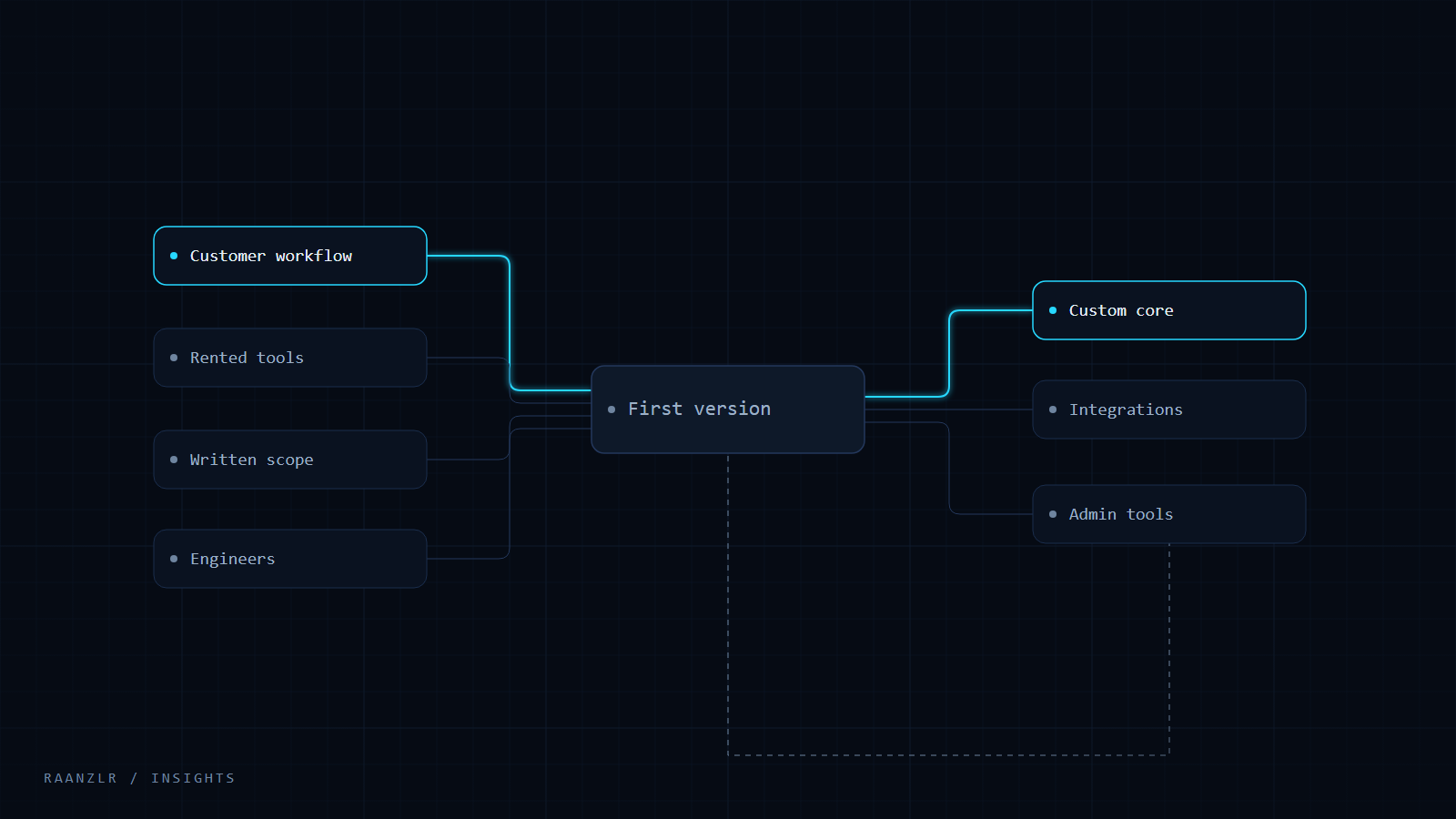
A US startup should write custom code only for the part of the product that customers pay for and that no off-the-shelf tool does well. Login, billing, email and analytics are solved problems. Rent them, and spend scarce engineering hours on the workflow that makes your product different.

That sounds obvious, and early teams break the rule all the time. They build an admin panel before they have real users, or pick a no-code tool for a core feature that later has to be rewritten. This guide covers where to draw the line, the common ways to get a first version built, what US engineering time costs and how AI coding tools change the math. For the general build-or-buy question outside startups, see our custom software vs SaaS guide.
02

Why the first build decision matters so much

Americans keep starting companies at a high rate. The Census Bureau's Business Formation Statistics counted about 5.7 million business applications in 2025, up from about 3.5 million in 2019 (sums of the monthly, not seasonally adjusted figures published on FRED in November 2026). Many applications come from sole proprietors who will never hire, so the count is a ceiling on new startups, not a count of them.

Survival is the harder number. The Bureau of Labor Statistics reported in October 2026 that 15.7% of US establishments born in 2000 were still operating in 2026. The first year is already a filter: among establishments born in 2022, first-year survival ranged from 74.4% in the Mountain states to 78.6% in the Middle Atlantic, according to a BLS release from March 2024.

For a software startup, the first build usually eats most of the early runway. A version that runs months late, or has to be rebuilt once the first real customers arrive, burns time a young company rarely has. The point of the first build is to learn whether customers will pay, as cheaply as the product allows.

US business applications per year, 2018 to 2025 (millions)

Source: U.S. Census Bureau, Business Formation Statistics, via [FRED series BABATOTALNSAUS](https://fred.stlouisfed.org/series/BABATOTALNSAUS), updated 12 November 2026. Annual sums of monthly, not seasonally adjusted applications; includes non-employer filings.

03

What to build custom and what to rent

Draw the line with one question for every feature: would a customer notice, and care, if this worked exactly like everyone else's version? If the answer is no, rent it.

Usually worth building

  • The core workflow your customer pays for, such as the scheduling logic in a clinic tool or the pricing engine in a freight marketplace.
  • Data models and integrations specific to your market, because they shape everything built after them.
  • Anything a buyer's security or compliance review will look at closely, where you need to explain exactly how it works.

Usually worth renting

  • Authentication, payments and subscription billing, plus transactional email and SMS.
  • Product analytics, error tracking and the support inbox.
  • Internal tools for the first months. A spreadsheet or a hosted admin panel is fine until a process repeats every day.

Renting has a cost too. Each service adds a monthly fee and another account to secure, and its API can change under you. Keep the list short and write down why each tool is there, so you can swap it out without a rewrite when the bill or the limits start to hurt.

04

Four ways to get the first version built

Most founders choose among four routes. The table compares them on what decides a first build: speed, who owns the code and what tends to go wrong.

For a funded founding team with no technical cofounder that needs a custom core, a small specialist team working to a fixed scope is usually the safer start. It can ship a first version without waiting the months a senior hire takes, and the startup keeps the repository. If a technical cofounder is already on board, hiring engineers around that person is the better long-term path, and outside help fits narrower pieces such as a mobile app or a single integration.

Whichever route you take, insist from day one that the code lives in a repository the company owns, with the deployment documented, and that someone other than the author reviews it.

Four ways to build a startup's first version
No-code plus SaaSFreelancerSmall specialist teamFirst in-house engineers
Best forTesting demand before writing codeOne well-defined feature or a prototypeA first version with a custom coreA long roadmap with a technical founder
Speed to a first versionFastestFast for small scopeFast once scope is fixedSlowest, hiring comes first
Who owns the codeTied to the platformWhatever the contract saysCompany repository, written into the contractThe company
Main riskRewrite when the product outgrows the toolOne person, thin testing and handoverScope creep and handover to the later teamSlow start and high fixed cost
When to move onPaying users need logic the tool cannot expressThe work becomes ongoingThe roadmap needs a full-time teamThis is the end state

Source: Raanzlr editorial comparison, November 2026. Qualitative; no vendor data.

05

What engineering time costs in the US

Salaries set the floor for any build budget. The BLS Occupational Outlook Handbook puts the median annual wage for US software developers at $135,980 in May 2025, and $134,040 for the wider group that includes QA analysts and testers. Half of developers earn more than that, and startups in the large tech hubs usually compete for the upper half.

The wage is only part of what an employee costs. Payroll taxes, benefits, equipment and recruiting time come on top, and a new hire usually needs a few weeks before shipping meaningful work. BLS also projects employment in this group to grow 10% from 2025 to 2035, much faster than average, so competition for experienced engineers is unlikely to ease soon.

This is why the scope of the first version matters more than the hourly rate of whoever builds it. A tight scope built by a more expensive team often costs less than a loose scope built cheaply, because the loose version gets rebuilt. Quotes from outside teams only mean something when they price the same written scope.

06

AI coding tools speed up the work, but review still decides quality

AI assistants are now part of how most developers work. In Stack Overflow's 2025 Developer Survey, 84% of respondents said they use or plan to use AI tools in development, up from 76% the year before. The same survey found more developers distrust the accuracy of AI output (45.7%) than trust it (32.7%), and the most common frustration, named by 66%, was answers that are almost right but not quite.

For a startup, that has a practical meaning. AI tools make a first draft of code and tests cheaper to produce. Someone who understands the system still has to review every change, and an almost-right bug in billing or permissions costs more than the time the tool saved. Ask any team you hire, in-house or outside, how they review AI-generated code and which tests run before a release.

Developers and AI tools, Stack Overflow 2025 survey (% of respondents)

Source: [Stack Overflow, 2025 Developer Survey: AI](https://survey.stackoverflow.co/2025/ai), July 2025. Self-reported survey; each figure is a share of respondents to that question.

07

Data rules to design for from the start

The US has no single federal privacy law covering most businesses, so the rules depend on where your users live. MultiState reported in October 2026 that 24 states now have comprehensive consumer privacy laws (23 if Florida's narrow law is left out), after Alabama, Louisiana, Oklahoma and Vermont enacted theirs in 2026. Thresholds and effective dates differ by state, and many small startups are not covered yet, but the requirements get hard to bolt on once a product has real users.

A few design choices keep later compliance cheap:

  • Record what personal data you collect and why, field by field, from the first database migration.
  • Build export and deletion for a single user early, since state privacy laws commonly give consumers those rights.
  • Keep production data out of test environments, and log who accessed what.
  • Expect enterprise buyers to send a security questionnaire before they sign. Clear access controls and audit logs make the answers short.

Sector rules such as HIPAA for health data, or financial regulation, sit on top of the state laws. If your product touches those areas, get legal advice before the data model is set.

08

How to scope a first version without overbuilding

A good first scope fits on one page. Write down:

  • The single customer action the product must support end to end, for example booking a job or approving an invoice.
  • What stays manual for now. Founders can handle onboarding and exceptions by hand until volume makes that painful.
  • The integrations you cannot launch without, usually one or two, and the ones that can wait.
  • What you will measure in the first month, such as activation or how long the task takes, and which result would change the plan.

Then cut anything that does not serve that one action. Design the screens before writing code, because a clickable prototype is cheaper to change than a database. Plan the second release around what the first users actually do, not around the original feature list.

The same page is what makes quotes comparable. Two teams pricing one written scope can be compared fairly. Two teams pricing a conversation cannot.

09

What this means for business automation

For a US startup, the useful starting point is a written scope for one customer workflow, then a first version that automates that workflow and rents everything around it. Raanzlr can design the screens and flows through UI/UX design, build the custom core as a web application or a mobile app, and connect it to payments, the CRM and other rented tools through CRM and API integrations. Repetitive back-office steps, such as onboarding emails or invoice follow-ups, can run as workflow automation instead of extra code. The code stays in a repository your company owns. For founders in the United States, each project starts from a one-page scope agreed before anything is built.

// FAQ

How much does custom software development cost for a startup?
It depends mostly on scope. A useful anchor is engineering time: the median US software developer earned $135,980 a year in May 2025, according to the Bureau of Labor Statistics, before benefits and payroll taxes. A narrow first version with one core workflow costs far less than a full platform. Compare quotes only against the same written scope, and ask each team what is excluded.
Should a startup use no-code tools or custom code for its MVP?
Use no-code while you are still testing whether anyone wants the product and the logic is simple. Move to custom code when paying users need behaviour the tool cannot express, or when a buyer's security review asks questions the platform cannot answer. Many startups combine the two, with a no-code admin side and custom code for the part customers actually use.
Should a non-technical founder hire a developer or an outside team?
Without a technical cofounder, hiring the first engineer is hard because you cannot easily judge their work. A small outside team on a fixed scope can ship a first version while you recruit, provided the company owns the repository and the handover is documented. Once the roadmap needs full-time work, bring engineering in-house and keep outside help for specialised pieces.
Who owns the code when an agency builds a startup's software?
Ownership is whatever the contract says, so put it in writing. The agreement should assign intellectual property to your company with the code in a repository you control from day one, and it should list deliverables such as deployment notes and credentials. Check for third-party components with restrictive licences, and make sure you can move the project to another team without anyone's permission.
Do AI coding tools make custom software much cheaper?
They lower the cost of first drafts, not the cost of getting things right. In Stack Overflow's 2025 survey, 84% of developers said they use or plan to use AI tools, yet 45.7% distrust their accuracy and 66% complain about answers that are almost right. Budget for review and testing, especially in billing and anything that handles personal data.

// Want to apply this?

Let's discuss how this applies to your business.

A senior engineer reviews every inquiry and responds within one business day.

Start a Conversation