AI Automation Services for US Businesses: Where to Start and What to Watch
Automation7 min readNovember 19, 2026

AI Automation Services for US Businesses: Where to Start and What to Watch

About a quarter of US businesses now report using AI, and big firms are well ahead of small ones. Here is how to pick a first process, do the cost math with US labor data and plan for the state rules arriving in 2027.

What do AI automation services do for US businesses?

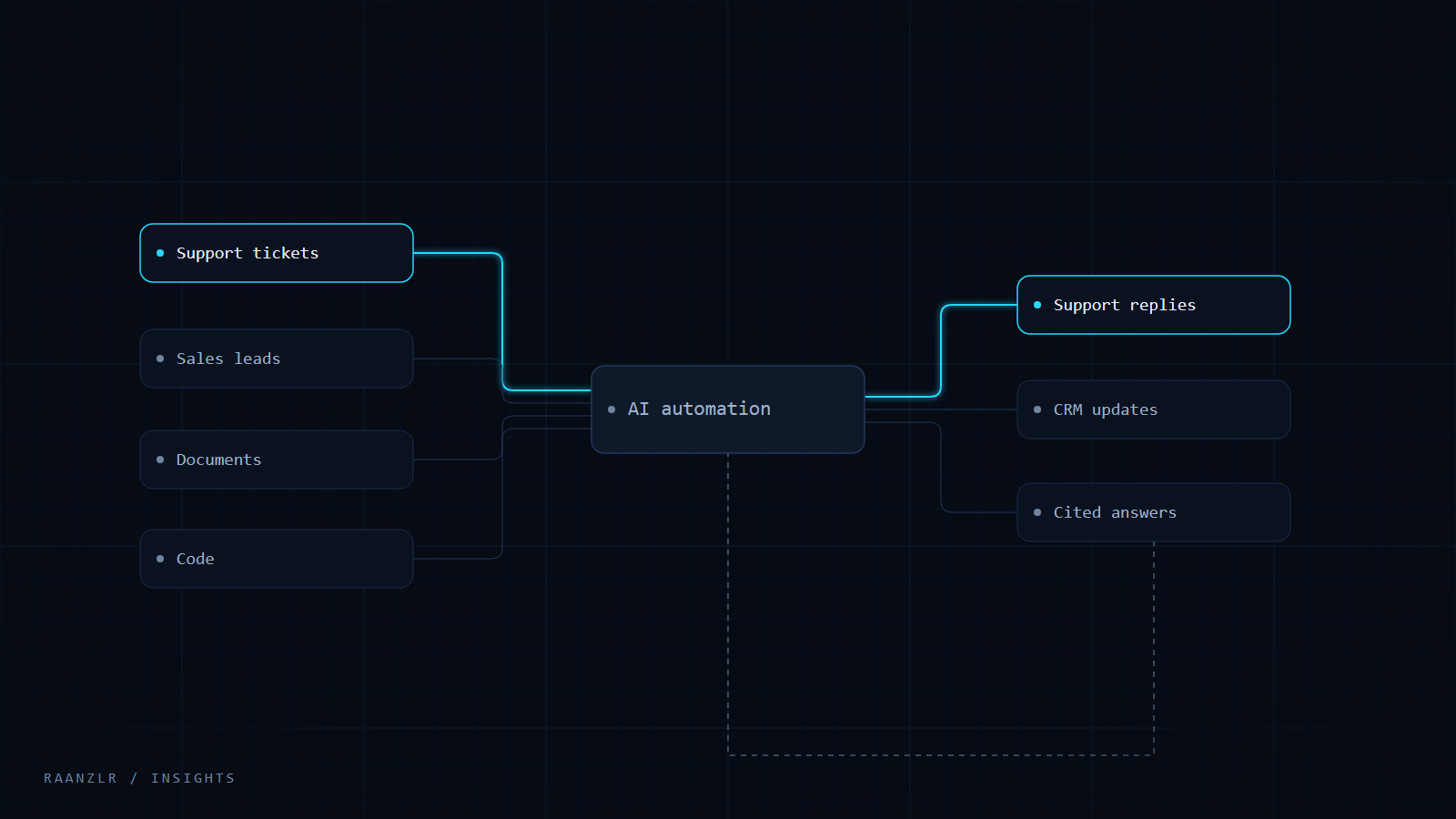
They hand repetitive work such as lead intake, support replies, invoice handling and reporting to software that runs inside the tools a company already uses, with people reviewing the steps that matter. Census Bureau data show about 23.8% of US businesses reported using AI in the two weeks ending 4 October 2026, so most companies are still choosing their first process.

01

The short answer: automate one costly process first

AI automation services move repetitive work, such as lead intake, support replies, invoice handling and weekly reporting, into software that runs inside the tools your team already uses. For most US companies the right first step is one process with a clear owner and a cost you can measure in staff hours. Its data should already sit in systems the software can reach. A company-wide AI program can come later.

The timing is reasonable. Census Bureau survey data show that close to a quarter of US businesses now report using AI somewhere in the business, and large firms are well ahead of small ones. This guide covers what those numbers say, how to price the work against US labor costs, the ways companies buy automation and the state rules that start applying in January 2027.
02

How many US businesses use AI now

The most useful public measure is the Census Bureau's Business Trends and Outlook Survey (BTOS), which asks US employer businesses every two weeks whether they used AI in the previous two weeks. Under the current wording, which counts AI use in any business function, the share stood at 17.3% in the period ending 30 November 2025 and reached 23.8% in the period ending 4 October 2026.

Read the series with two breaks in mind. The Bureau broadened the question in November 2025. Under the old wording, which asked only about producing goods or services, the rate was about 10% in late 2025, according to the Federal Reserve Bank of Minneapolis, so part of the jump is a definition change. Then, from the 19 October 2026 collection, the question was reworded again to refer to "Super Intelligence or SI (formerly referred to as Artificial Intelligence or AI)", as Simon Willison noted. Later readings may not line up with this chart.

The direction holds across both changes. More than seven in ten US businesses still did not report using AI in the latest period shown, so most companies are early.

US businesses using AI in the last two weeks (%)

Source: U.S. Census Bureau, Business Trends and Outlook Survey, national rate under the revised any-business-function wording, two-week periods ending 30 Nov 2025, 25 Jan, 22 Mar, 31 May, 26 Jul, 20 Sep and 4 Oct 2026. Values as compiled from the Census workbooks by [The Latent](https://thelatent.co/data/demand/census-btos-ai-adoption-overall), read 19 November 2026. Official survey data.

03

Bigger firms are further ahead

Adoption climbs with headcount. In the period ending 4 October 2026, 40.7% of businesses with 250 or more employees reported using AI, compared with 21.1% of businesses with five to nine. The Minneapolis Fed saw the same pattern in the Bureau's April 2026 supplement: 30% of firms with at least 250 employees used AI, against 17% of firms with fewer than 20.

The reasons nonadopters give are practical. In the Minneapolis Fed's reading of the survey, roughly 20% of businesses not using AI cited safety concerns, and a similar share said they lacked knowledge of what AI can do. Neither problem comes down to budget alone. A 15-person company rarely has anyone whose job is to build an automation and keep watching it once it runs, and that gap is what an outside service fills.

US businesses using AI, by number of employees (%)

Source: U.S. Census Bureau, Business Trends and Outlook Survey, release of 22 October 2026, period ending 4 October 2026, six-survey trailing average, as reported by [Simon Willison: The U.S. Census Bureau and Super Intelligence](https://simonwillison.net/2026/Nov/2/census-bureau-super-intelligence/), 2 November 2026. Official survey data.

04

Where automation pays off first

Among business functions in the April 2026 supplement, sales and marketing had the most AI use, at about 15% of firms. That matches where automation is easiest to justify: work that repeats in volume and ends in a record in some system.

Good first candidates usually look like this:

  • Lead intake and routing, where a form or email becomes a qualified record in the CRM with the right owner.
  • First replies on support, where an AI agent answers routine questions from your own policies and hands the rest to a person.
  • Documents such as invoices and purchase orders, where fields are read and checked before posting.
  • Recurring reports that someone assembles by hand from several exports every week.

The Minneapolis Fed also found that about 96% of AI-using firms reported no change in total employment over the previous six months, while 10% said AI now performs tasks employees used to do. In practice people move from typing data to checking it and handling the exceptions.

05

Doing the cost math with US labor costs

Before you compare vendors, work out what the manual version costs. The Bureau of Labor Statistics reports that private employers paid an average of $46.89 per hour worked in total compensation in June 2026, made up of $32.82 in wages and $14.07 in benefits. For full-time workers the figure was $54.00.

A simple illustration: if a process takes 10 staff hours a week, it costs about $469 a week at the all-worker average, or roughly $24,400 a year. That is our arithmetic on the BLS average, not a measured result, and your own number will differ by role and city.

That figure is the bar any automation proposal has to clear once you add build cost, software subscriptions, model usage and the hours someone still spends reviewing output. If a vendor cannot tell you which hours go away and which remain, the proposal is not ready.

06

Three ways to buy AI automation

US companies usually end up with one of these models, and many use more than one for different processes. AI features already inside your CRM or accounting software are the cheapest place to start when the whole process lives in that tool. A no-code platform such as Zapier or n8n suits simple handoffs between apps that a team member can own.

We would pick the third column for the common case where a process crosses several systems and needs a human approval step with an audit trail. That is where off-the-shelf connectors start to break quietly, and someone has to own the logic and watch for errors.

AI automation service models compared
AI features in your existing softwareNo-code automation platformCustom automation built with a partner
Best forWork that stays inside one toolSimple handoffs between a few appsProcesses across several systems with approvals
Setup effortLow, mostly configurationLow to moderateModerate, starts with process mapping
Who maintains itThe software vendorA team memberThe partner, with handover to your team
Exceptions and reviewLimited to what the vendor offersBasic, gets fragile as flows multiplyDesigned in from the start
Main riskTied to one vendor's roadmapSilent failures nobody noticesHigher upfront cost if scoped too wide

Source: Raanzlr analysis, November 2026.

07

State rules to plan for in 2027

No single federal AI law governs private businesses, so the obligations come from states and cities, and they focus on automated decisions about people.

  • In Colorado, SB 26-189, signed on 14 May 2026, replaced the state's original AI Act with a narrower disclosure law. From 1 January 2027, businesses using automated decision-making technology for consequential decisions must give notice beforehand and, after an adverse outcome, tell people they can correct their data and ask for human review. The Attorney General enforces it, with penalties of up to $20,000 per violation, according to Arnold & Porter.
  • In California, the Privacy Protection Agency finalized its rules on automated decision-making technology in July 2025. Businesses that use it for significant decisions must comply from 1 January 2027.
  • In New York City, Local Law 144 has required a bias audit within the past year, a public audit summary and notices to candidates before employers use automated hiring tools, with enforcement since 5 July 2023.

Federal and state positions are also pulling apart. In July 2026 the FTC proposed a policy statement saying Colorado's law may be preempted by the FTC Act. For most back-office automation this changes little. Anything that decides on hiring, credit, housing or insurance needs human review and decision logs built in from day one. This is general information, not legal advice.

08

How to scope a first project

A short scoping exercise saves more money than any tool choice.

  • Pick one process and name its owner.
  • Count the hours it takes today and the errors it causes, using a normal month.
  • Check that the data lives in systems with an API or a reliable export.
  • Decide which steps a person must approve, and write that down before anyone builds.
  • Run a pilot on real volume for a few weeks, then compare hours and error counts against the baseline.

If the pilot does not beat the baseline, stop or change the scope. A good partner will tell you the same.

09

What this means for business automation

For US companies the opening is in processes that cross systems and still depend on someone copying data between them. Raanzlr can map one of those processes, measure its current cost in staff hours and build the automation around it: workflow automation for approvals and handoffs, AI agents that answer from your own documents and pass edge cases to a person, and CRM and API integrations so every step writes back to the system of record. We can add dashboards that compare hours and error rates before and after. For teams in the United States, the work can include human review steps and decision logs for processes that the 2027 Colorado or California rules may cover.

// FAQ

How much do AI automation services cost for a US business?
Price depends on how many systems the automation touches and how much human review the process needs, so treat any quote without a scoped process as a guess. A useful yardstick is staff time: US private employers paid an average of $46.89 per hour worked in total compensation in June 2026, according to the Bureau of Labor Statistics. Ask for a fixed-scope pilot and price it against that.
Do small US businesses use AI automation?
Fewer of them do, but plenty have started. In the Census Bureau survey period ending 4 October 2026, 23.3% of businesses with one to four employees reported using AI, against 40.7% of businesses with 250 or more. Small firms usually lack someone to set up and maintain automations, which is where an outside service tends to help most.
Do US AI laws apply to automating customer service or back-office work?
Mostly they target automated decisions with real consequences for people, such as hiring, lending, housing or insurance. Colorado's revised law and California's ADMT rules both start applying on 1 January 2027, and New York City already requires bias audits for automated hiring tools. Routing tickets or drafting replies usually falls outside them, but check with counsel before automating any decision about a person.
Will AI automation replace staff at my company?
Early evidence points to task changes more than job cuts. The Federal Reserve Bank of Minneapolis reported in May 2026 that about 96% of AI-using firms in the Census survey saw no change in total employment over six months, while 10% said AI now performs tasks employees used to do. Most projects move people from data entry to checking work and handling exceptions.

// Want to apply this?

Let's discuss how this applies to your business.

A senior engineer reviews every inquiry and responds within one business day.

Start a Conversation