Custom Software Development for Canadian Companies: Costs, SR&ED and the Rules to Build In
Custom Software9 min readNovember 25, 2026

Custom Software Development for Canadian Companies: Costs, SR&ED and the Rules to Build In

Developer time is the main cost of custom software in Canada, and Job Bank puts the median wage at $50.00 an hour. Here is when building beats renting, what the 35% SR&ED credit covers, and which French, accessibility and privacy rules to design in.

When should a Canadian company build custom software?

When the process is specific to how the company operates and packaged tools force workarounds, such as retyping data between systems or doing without a French interface. Standard functions are cheaper to rent. Budget from developer wages, which Job Bank puts at a national median of $50.00 an hour, and plan early for Quebec's French-language rules, Ontario's accessibility standard and where the data will be hosted.

01

The short answer: build the part that is yours, and plan for Canadian rules early

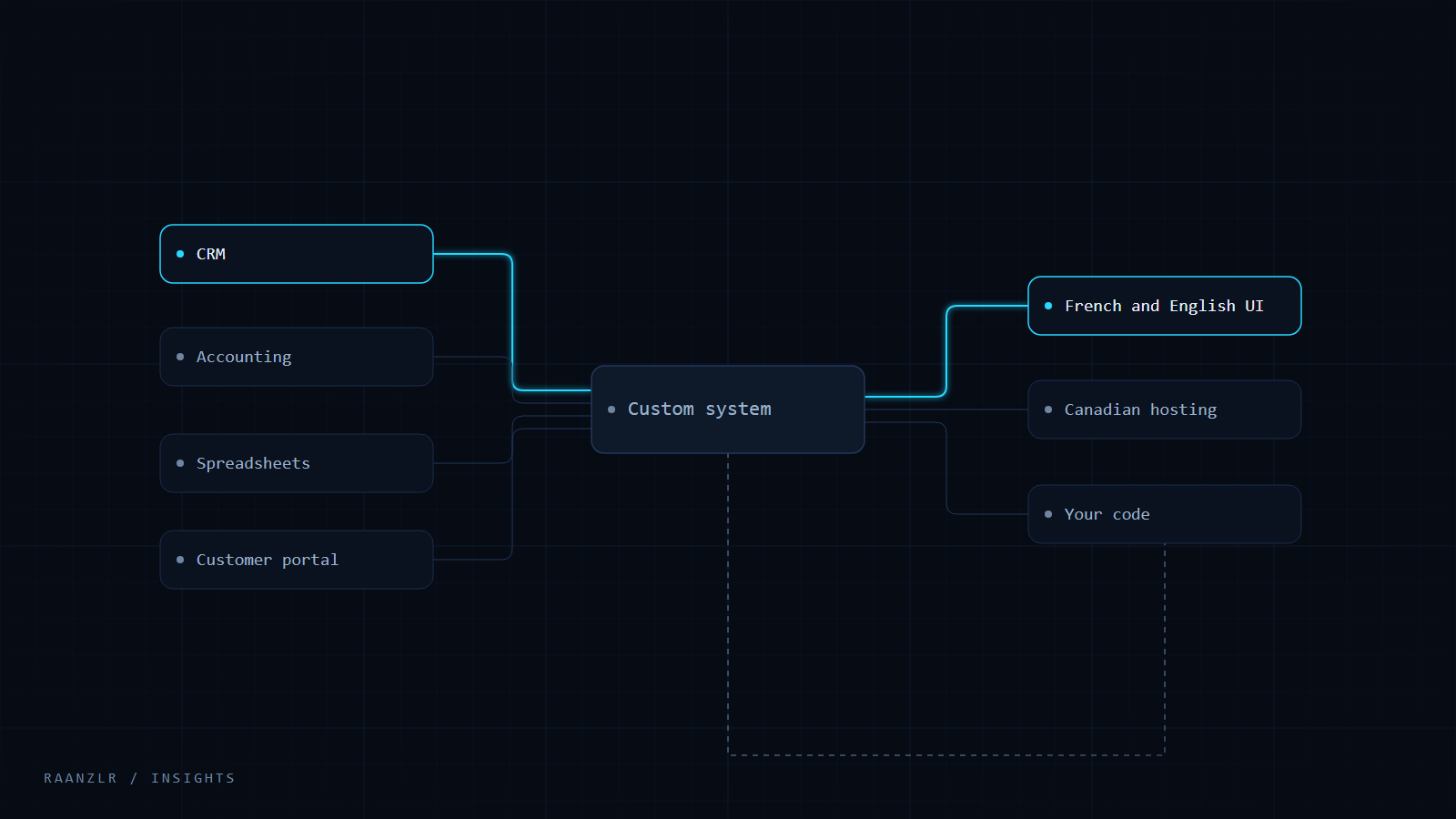
Custom software pays off for a Canadian company when the work it supports is specific to how that company operates and no packaged product fits without workarounds. Standard jobs such as accounting and payroll are cheaper to rent. Build the part that is yours and connect it to the rest.

Three things make the Canadian case its own. Developer time is the main cost, and the Government of Canada's Job Bank puts the median wage for software developers at $50.00 an hour. The federal SR&ED credit can refund 35% of qualifying development spending, though far less work qualifies than founders tend to hope. And some rules reach into the software itself. Quebec expects French versions of the tools staff use, and Ontario sets an accessibility standard for public websites. Both are easier to design in than to add after launch.
02

When custom software makes sense

Most Canadian businesses already rent software. In Statistics Canada's Survey of Digital Technology and Internet Use, 48% of businesses with five or more employees used cloud computing in 2023, up three percentage points from 2021, which made it the most common technology in the survey. The release came out in September 2024 and is the latest from that survey. So the question for most firms is what to add to tools they already pay for.

Custom work earns its cost in a few situations:

  • The process is the reason customers choose you, and a packaged tool would force you to run it the way everyone else does.
  • Staff copy the same data between three or more systems because no product connects them.
  • You pay per-seat licences that grow faster than the value you get from them.
  • A rule you must follow, such as a French interface or an audit trail, is missing from the product and the vendor will not add it.
  • You need a customer or partner portal that reflects your own pricing and approvals.

If none of those apply, configure what you have. We go through that trade-off in more depth in custom software vs SaaS.

03

Who builds it: three options

A company that has decided to build still has to choose who writes the code. The options differ less in price per hour than in what happens after launch.

An in-house team gives you the most control and the slowest start, since you have to recruit before anyone writes a line. An external partner starts sooner and suits a company with no engineering manager, provided the contract hands you the code and the cloud accounts along with the documentation. Extending a packaged platform with integrations is the cheapest route when the gap is small, but it leaves you tied to the vendor's pricing and roadmap.

For a first system at a company without engineers, we would pick the middle column. Hiring a team for one project leaves you paying salaries after the project ends, and the Job Bank numbers in the next section show what those salaries look like. Whichever you choose, write code ownership into the agreement before work starts.

Three ways to get custom software built
In-house teamExternal development partnerPackaged platform plus integrations
When work startsAfter recruitingAfter a scoping phaseSoonest, once the platform is configured
Main costSalaries and benefits, ongoingProject fee, then a support retainerPer-seat licences plus integration work
Who owns the codeYouYou, if the contract says soThe vendor owns the platform; you own your integrations
Main riskHiring delays, and idle staff between projectsDependence on the partner unless you hold the code and accountsChanges to the vendor's pricing and roadmap
Fits whenYou will keep building for yearsYou need one system built well and maintainedThe gap between product and process is small

Source: Raanzlr summary, November 2026. A qualitative comparison, not measured data.

04

What developers cost in Canada

Developer time is most of the bill, so start with wages. Job Bank, drawing on Statistics Canada's Labour Force Survey for 2024 and 2025, reports a national median of $50.00 an hour for software developers. The low end of its range is $30.87 and the high end is $79.33. Figures are in Canadian dollars and were updated on 18 November 2026.

Location moves the number. British Columbia has the highest provincial median at $55.29, followed by Ontario at $51.28. Quebec sits at $47.12. Manitoba, at $42.31, is the lowest of the ten provinces, and Job Bank publishes no figure for the three territories.

A rough illustration helps. At the national median, one developer working 1,950 hours a year (37.5 hours a week) earns $97,500 in wages. Three developers for six months come to about $146,000. That is our arithmetic on the median wage, before benefits, payroll contributions, tools, management, design and testing, and it should not be read as a quote. An agency's hourly rate will be higher than a wage because it carries those costs.

The number is most useful for checking a proposal. Divide the price by the hours in the plan and compare the result with these wages. If the implied rate is below what developers earn, ask where the work will be done and by whom.

Median hourly wage of software developers by province (C$ per hour)

Source: [Government of Canada Job Bank: Wages, Software Developer in Canada](https://www.jobbank.gc.ca/marketreport/wages-occupation/22548/ca), NOC 21232, updated 18 November 2026. Labour Force Survey, reference period 2024 to 2025. Official data; no figures are published for the territories.

05

SR&ED: what the tax credit covers and what it leaves out

The Scientific Research and Experimental Development program, SR&ED for short, is the federal incentive most often mentioned alongside software. The headline is generous. According to the Canada Revenue Agency, most Canadian-controlled private corporations can earn a refundable credit at an enhanced rate of 35% on qualified spending up to $6 million a year, and 15% above that. The limit was $3 million until Bill C-15 doubled it for tax years beginning after 15 December 2024. The bill received royal assent on 26 March 2026. The limit shrinks once a company's taxable capital in Canada passes $15 million and disappears at $75 million.

The catch is eligibility. The CRA's test asks whether the work sought a technological advancement and whether there was real uncertainty about reaching the result. It also expects a systematic investigation, with a hypothesis that is tested and conclusions drawn from the tests. Computer programming counts only when it directly supports work of that kind. Routine data collection, quality control, style changes and commercial use of a finished product are excluded.

Most business software is built from known techniques. A customer portal or an approvals workflow will usually fail the uncertainty test, however useful it is. A scheduling engine with constraints nobody has solved at your scale might pass.

Since 1 April 2026 the CRA has offered an optional pre-claim approval process that returns a determination within eight weeks. If SR&ED is part of your budget, use it before you commit. Until then, leave the credit out of the business case, and ask a tax adviser who gets to claim when a contractor does the work.

06

Rules to design in from the start

French in Quebec

If you have staff in Quebec, the Office québécois de la langue française says an employer must give them the French version of any software they use, including applications built in house, installed by default on their workstations. A custom system therefore needs a French interface on day one, with every label and message stored so it can be translated. Businesses with 25 or more employees in Quebec over six months must also register with the Office and go through francization, a threshold that DLA Piper notes was lowered on 1 June 2025. Customer-facing sites and contracts fall under separate rules. Check those with Quebec counsel.

Accessibility in Ontario

Ontario's accessibility law, the AODA, has required since 1 January 2021 that businesses and non-profits with 50 or more employees make their public websites meet WCAG 2.0 Level AA, apart from the criteria on live captions and pre-recorded audio description. The province's guidance defines content as anything found on a web page or web application. Internal sites are exempt, though a person can still ask for the content in an accessible format. The same guidance suggests asking a developer whether they test with both automated and manual checks, and with assistive technology such as a screen reader.

Where the data lives

Federal privacy law does not require Canadian hosting. The Privacy Commissioner's guidance on cross-border processing, published in 2009, says PIPEDA does not prohibit transferring personal information to another jurisdiction for processing. The organization stays accountable for it and must secure comparable protection through contracts. It should also tell people that their information may be processed abroad, where foreign authorities may be able to reach it. The guidance does not cover provincial privacy laws, so check those separately. Custom software lets you choose a Canadian cloud region, which is often simpler than explaining why you chose another. Quebec's stricter regime and the federal Bill C-36 are covered in our guide to AI automation for Canadian businesses. This is general information, not legal advice.

07

How to scope the first release

A first release should be small enough to finish and useful enough that people switch to it. A scoping document of about two pages can usually cover the following:

  • The one process the system replaces, and who owns it.
  • The systems it must read from and write to, and whether each has an API.
  • The languages of the interface, with French listed if anyone in Quebec will use it.
  • The accessibility standard, named in the contract.
  • Where the data is hosted and who can access it.
  • Who holds the source code, the cloud accounts and the domain.
  • What happens after launch: who fixes bugs, how quickly and at what monthly cost.

Ask each bidder to price that document rather than their own reading of it. The proposals become comparable, and the gaps between them show you which parts of the scope are unclear. Then hold back anything people do not need in order to stop using the old spreadsheet.

08

What this means for business automation

For Canadian companies, custom software is most useful as the layer that connects systems you already pay for and removes the manual steps between them. Raanzlr can scope a first release with you and then build it: custom web platforms for portals and internal tools, CRM and API integrations so data moves without retyping, and dashboards that report from the same records. Where a process has repetitive decisions, workflow automation can sit inside the new system with a person approving the steps that matter. For teams in Canada, we can build bilingual interfaces using French copy your team supplies, test against WCAG 2.0 Level AA, host in a Canadian cloud region and hand over the code and accounts at the end.

09

References

// FAQ

How much does custom software development cost in Canada?
It depends on scope, so treat any figure given without a scoping document as a guess. Developer wages are the anchor. Job Bank reports a national median of $50.00 an hour for software developers, with a range of $30.87 to $79.33, in data updated in November 2026. Agency rates run higher because they also carry benefits, management, design and testing. Ask bidders to price the same written scope, then compare the implied hourly rates.
Does custom software development qualify for SR&ED?
Only the part that involves technological uncertainty. The Canada Revenue Agency requires a systematic investigation aimed at a technological advancement, and it excludes routine work. A portal or workflow built from known techniques will usually not qualify. Eligible work by most Canadian-controlled private corporations can earn a 35% refundable credit on up to $6 million of spending a year. The CRA's optional pre-claim approval, available since April 2026, gives a determination within eight weeks.
Does business software used in Quebec have to be in French?
For staff, yes. The Office québécois de la langue française says employers must provide the French version of any software their employees use, including applications built in house, installed by default. Businesses with 25 or more employees in Quebec over six months must also register with the Office for francization. Customer-facing websites and contracts fall under separate rules, so confirm those with a Quebec lawyer before launch.
Do Canadian companies have to host their data in Canada?
Federal privacy law does not require it. The Privacy Commissioner's guidance says PIPEDA does not prohibit transferring personal information to another jurisdiction for processing. The company stays accountable, must secure comparable protection by contract and should be open about where the data goes. Provincial laws sit outside that guidance and need a separate check. With custom software, picking a Canadian cloud region is a design decision you control.

// Want to apply this?

Let's discuss how this applies to your business.

A senior engineer reviews every inquiry and responds within one business day.

Start a Conversation