AI Agents for Canadian Customer Support Teams: French, Liability and Handoffs
AI Agents8 min readNovember 26, 2026

AI Agents for Canadian Customer Support Teams: French, Liability and Handoffs

A practical guide for Canadian support leaders: where AI agents help, what the Air Canada chatbot ruling means, and how Quebec's French and privacy rules shape the design.

Should Canadian support teams use AI agents?

Yes, for repeat questions with documented answers, as long as the agent answers in French and English, hands off to a person easily and is checked against current policy. A 2024 British Columbia tribunal held Air Canada liable for its chatbot's wrong answer, and Quebec law gives consumers the right to be served in French, so accuracy and language are design requirements from day one.

01

The short answer: automate the documented questions, in both languages, and own every reply

Canadian support teams can hand repeat questions to an AI agent today, provided the agent answers from current, approved policy, works in French and English, and passes customers to a person without a fight. Each of those conditions traces back to Canadian law or a tribunal ruling.

The case that set the tone is Moffatt v. Air Canada. In February 2024 a British Columbia tribunal ordered the airline to pay for a bereavement-fare answer its website chatbot got wrong, and it rejected the idea that the chatbot was responsible for its own words. Quebec adds two more requirements: consumers have a right to be served in French, and since 2023 Law 25 requires notice when a decision about a person is made only by automated processing.

The rest of this guide covers where Canadian businesses stand with chatbots, what customers say, the rules to design for, and how to set up an agent that a support leader can defend.
02

Where Canadian businesses stand with chatbots

Statistics Canada's spring 2026 survey found that 19.2% of businesses used AI to produce goods or deliver services in the previous 12 months, up from 12.2% a year earlier and 6.1% two years earlier. Among the businesses using AI, 28.2% used virtual agents or chatbots, up from 24.8% in 2025. Only data analytics (36.6%) and text analytics (34.5%) were more common.

Size changes the picture. Among AI-using businesses with 100 or more employees, 50.5% used virtual agents or chatbots. Larger firms have the ticket volume that makes an agent worth building, and they are more likely to have a help centre and ticket history to train it on.

Customer-facing use is also where plans are growing. In Statistics Canada's 2025 survey of expected AI use, the share of businesses planning to use virtual agents or chatbots rose from 18.7% to 34.8% in one year, making chatbots the most common planned use. Staffing changes so far are mostly about training: in the 2026 survey, 44.4% of AI users changed training or staffing practices, and the most common change was training existing employees (32.0%).

03

What Canadian customers say

The best recent Canadian read on customer attitudes comes from a vendor: Salesforce commissioned an Angus Reid Forum survey of 1,500 Canadians in May 2025. It is a single survey, but the pattern is useful. More than half (55%) said they don't mind whether a person or AI helps them as long as the issue is resolved quickly. Yet 49% were unconvinced that agentic AI would improve their experience, and only 34% said they trust AI-generated information.

The frustrations they named are the ones a badly built agent makes worse: 59% cited unhelpful self-service and 55% cited being transferred too many times. Read together, the numbers say customers judge the outcome. An agent that resolves the question wins; one that loops, guesses or blocks the path to a person feeds the two biggest complaints.

What Canadians said about AI in customer service, May 2025 (% of respondents)

Source: [Salesforce Canada: How Canadian Leaders Can Overcome Hesitancy and Drive AI Adoption](https://www.salesforce.com/ca/blog/how-canadian-leaders-can-overcome-hesitancy-and-drive-ai-adoption/), 28 July 2025. Online survey of 1,500 Canadians by Angus Reid Forum, 27 to 29 May 2025. Vendor-commissioned.

04

The Air Canada ruling: your agent's answers are your answers

Jake Moffatt asked Air Canada's website chatbot about bereavement fares after a death in the family. The chatbot said he could apply for the reduced fare after travelling, which contradicted the airline's own policy page. When the refund was refused, he went to British Columbia's Civil Resolution Tribunal.

Air Canada argued that the chatbot was a separate entity responsible for its own actions. The tribunal called that a remarkable submission, found that the airline had not taken reasonable care to make the chatbot accurate, and held it liable for negligent misrepresentation. The order was small: $650.88 in damages, $36.14 in interest and $125 in tribunal fees, $812.02 in total. The principle is what matters for a support team:

  • Every answer is a company statement. The tribunal saw no difference between a chatbot reply and a static web page.
  • Customers are not expected to cross-check. Mr. Moffatt had no reason to think one part of the website was more reliable than another.
  • Accuracy is a process. Ground the agent in the same policy documents your staff use, update both together, and log what it said so you can find and correct errors.
05

French is a design requirement

Quebec's Charter of the French Language gives consumers the right to be informed and served in French, and the Office de la protection du consommateur lists it among consumer rights in the province. For an AI agent that means the French experience has to work as well as the English one: the knowledge base, the handoff queue and the confirmation messages all need a French version that a person has checked.

The regulator's numbers show why. The Office québécois de la langue française received 10,371 complaints in 2024-2025, up 13.7% in a year, and complaints about the language of service grew from 25% to 40% of the total over five years. A bilingual agent that sends French speakers to an English-only human queue produces exactly that complaint.

Federal law may add to this. The Use of French in Federally Regulated Private Businesses Act, passed in 2023, gives consumers in Quebec the right to communicate in French with federally regulated businesses such as banks, airlines and telecoms. As of October 2026 that provision is not yet in force, so watch it if you operate in those sectors.

06

Privacy and accessibility rules to build in

Canadians are uneasy about AI and their data. In a telephone survey for the Office of the Privacy Commissioner of Canada in early 2025, 83% said they were at least somewhat concerned about their privacy when using AI tools, and 88% were concerned about their personal information being used to train AI systems. A support agent sees order histories, addresses and account details, so say clearly what it stores and keep customer conversations out of model training unless you have consent.

Automated decisions under Law 25

Since September 22, 2023, Quebec's private-sector privacy law requires an organization to tell a person when it uses their personal information to make a decision about them based only on automated processing. On request it must share the information and the main factors behind the decision, and the person can submit observations and ask for a review by a person. An agent that answers questions stays clear of this. An agent that approves or refuses refunds, credits or claims on its own does not, so either route those decisions to staff or build the notice and review path.

Accessibility

In Ontario, businesses and non-profits with 50 or more employees must make public websites meet WCAG 2.0 Level AA under the AODA, and a chat widget on that site is part of it. Federally regulated organizations also have duties under the Accessible Canada Act, including accessibility plans and a feedback process, with penalties of up to $250,000 per violation.

Canadians' privacy concerns about AI, early 2025 (% of respondents)

Source: Office of the Privacy Commissioner of Canada: 2024-2025 Public Opinion Research on Privacy Issues, March 2025. Telephone survey of 1,500 Canadians aged 16 and over by Phoenix SPI, 10 February to 3 March 2025. Government-commissioned.

07

Three ways to set up the agent

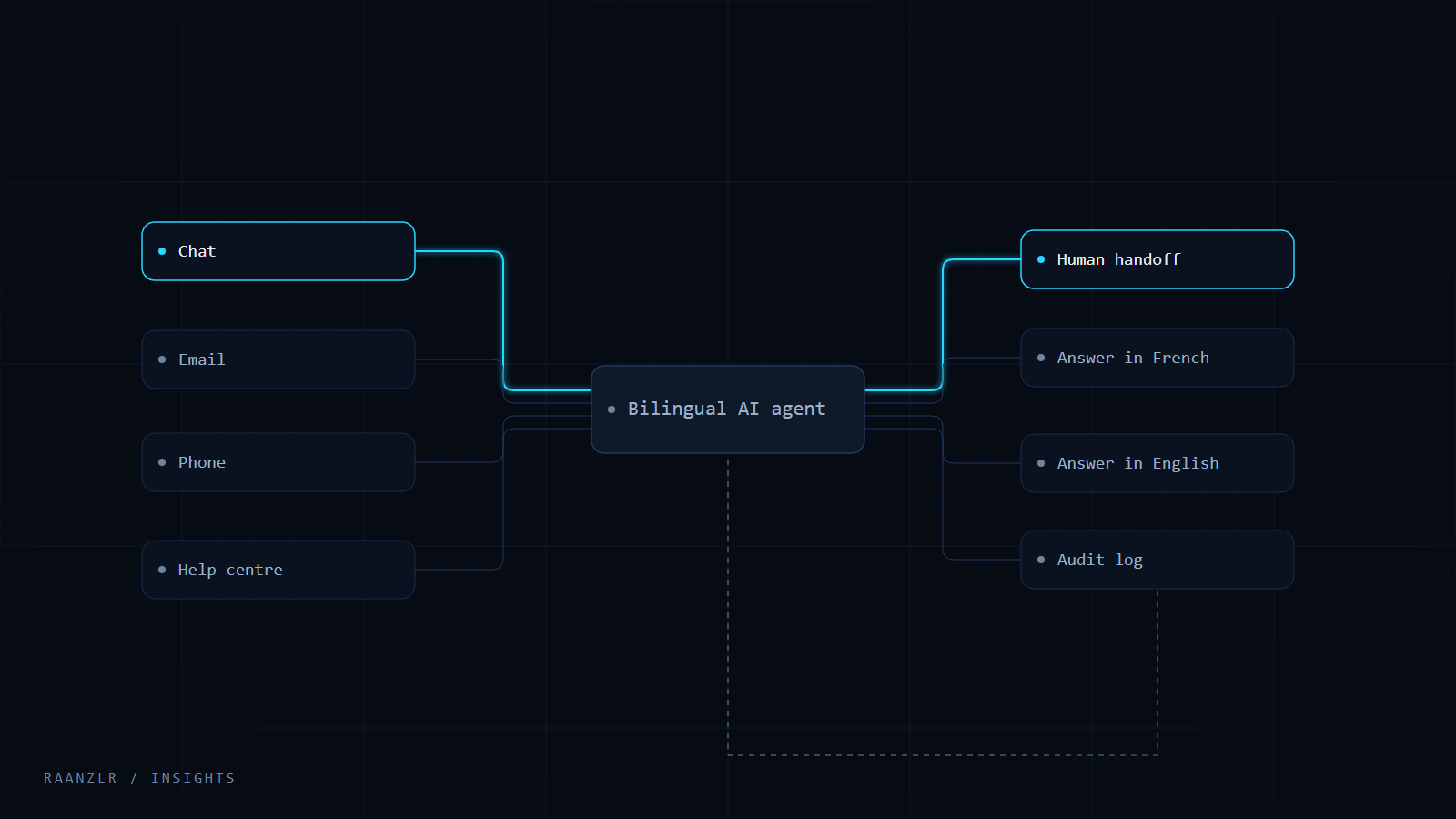
Most Canadian teams will choose between three setups. For a team that serves Quebec and the rest of the country, we would pick the middle column: a bilingual agent that answers documented questions, logs every reply and hands anything else to a person who speaks the customer's language. It takes the bulk of repeat contacts while keeping money decisions, and therefore most of the Law 25 exposure, with staff.

Agent assist suits regulated teams that want AI drafting replies before they let it talk to customers. Full automation, where the agent also issues refunds or changes accounts, needs the most integration work and the Law 25 notice and review path, so it is usually a second phase.

AI agent setups for a Canadian support team
Agent assistBilingual agent with human handoffFully automated agent
What it doesDrafts replies and summaries; a person sends themAnswers documented questions in French and English; a person takes the restAnswers and acts: refunds, credits, account changes
Moffatt-type riskLow: staff check each replyManaged: answers come from approved policy and are loggedHighest: wrong answers and wrong actions reach customers
French service in QuebecDepends on staffBuilt in, including a French-speaking handoff queueBuilt in, but every action flow needs French too
Law 25 automated decisionsNot triggeredUsually not triggered if money decisions stay with staffTriggered: notice, explanation and human review needed
What you need firstTicket history and reply guidelinesA bilingual knowledge base and a clear handoff ruleSystem integrations with permissions and audit logs

Source: Raanzlr analysis based on Moffatt v. Air Canada, 2024 BCCRT 149 (February 2024), Quebec's Charter of the French Language and Law 25 as summarized by Clyde & Co (September 2023). Not legal advice.

08

The cost side and how to measure it

Job Bank puts the national median wage for customer service agents at $23.75 an hour, in data updated in November 2026, and counted about 181,900 people in the occupation in 2025. Its 2026 to 2035 national outlook is balanced, and three-year prospects are rated limited in Quebec and very limited in Ontario. A realistic goal is fewer repetitive contacts per agent and more staff time for cases that need judgment.

Measure the agent like a new team member, in both languages separately:

  • Resolution rate: contacts closed without a person, checked against a sample of real conversations rather than the agent's own label.
  • Handoff quality: time to reach a person, and whether the customer had to repeat themselves.
  • Accuracy: a weekly review of answers against current policy, the habit that would have caught the Air Canada error.
  • Language parity: French and English satisfaction and resolution side by side. A gap is an early sign of a complaint.
09

What this means for business automation

For a Canadian support team, the agent is the visible part. The work underneath is a bilingual knowledge base tied to your real policies, a handoff that lands with someone who speaks the customer's language, and a log of every answer. Raanzlr can build AI support agents that answer from your own documents through retrieval over your policies and help centre, connect them to your helpdesk and CRM through CRM and API integrations, and set up workflow automation that routes refunds and other decisions to staff for approval. We design for Canadian businesses with French and English from the start and with logs you can review.

10

References

// FAQ

Is a Canadian company liable for what its AI chatbot tells customers?
On the current case law, yes. In Moffatt v. Air Canada (February 2024), British Columbia's Civil Resolution Tribunal rejected the argument that the chatbot was responsible for its own statements and ordered the airline to pay $812.02. The tribunal said it makes no difference whether wrong information comes from a static page or a chatbot. Treat every agent answer as a company statement.
Does an AI support agent have to speak French in Quebec?
If you serve consumers in Quebec, plan for it. The Charter of the French Language gives consumers the right to be informed and served in French, and the OQLF received 10,371 complaints in 2024-2025, with language of service making up 40%. An agent that only answers in English, or hands French speakers to an English-only queue, creates exactly the complaint the regulator sees most.
What does Quebec's Law 25 require for AI in customer service?
Since September 22, 2023, an organization that makes a decision about a person based only on automated processing of their personal information must tell them. On request it must explain the information and main factors used, and the person can ask for a human review. A support agent that only answers questions is less exposed than one that approves refunds or denies claims on its own.
How many Canadian businesses use AI chatbots?
Statistics Canada reported that 19.2% of businesses used AI to produce goods or deliver services in the year before its spring 2026 survey. Among those users, 28.2% used virtual agents or chatbots, up from 24.8% a year earlier. In businesses with 100 or more employees that use AI, the share using chatbots was 50.5%.

// Want to apply this?

Let's discuss how this applies to your business.

A senior engineer reviews every inquiry and responds within one business day.

Start a Conversation