AI Automation Services for Canadian Businesses: Adoption, Costs and Privacy Rules
Automation8 min readNovember 24, 2026

AI Automation Services for Canadian Businesses: Adoption, Costs and Privacy Rules

Nearly one in five Canadian businesses now uses AI, triple the share two years ago. Here is who is ahead, how to price a first project against Canadian wages, and why Quebec's rules are the ones to design for while Bill C-36 waits in Parliament.

What do AI automation services do for Canadian businesses?

They move repetitive work such as lead intake, support replies, invoice handling and reporting into software that runs inside the tools a company already uses, with people approving the steps that matter. Statistics Canada found 19.2% of businesses used AI to produce goods or deliver services in the 12 months before its second-quarter 2026 survey, up from 6.1% two years earlier, so most firms are still choosing a first process.

01

The short answer: start with one process and design for Quebec's rules

AI automation services take repetitive work, such as lead intake, support replies, invoice handling and weekly reporting, and move it into software that runs inside the tools your team already uses. For most Canadian companies the sensible first project is one process with a named owner and a cost you can count in staff hours. Its data should already sit in systems the software can reach.

Two things set the Canadian case apart from the US one. Adoption is rising quickly from a low base: Statistics Canada found that 19.2% of businesses used AI to produce goods or deliver services in the year before its spring 2026 survey, triple the share two years earlier. And the privacy rules are moving. Quebec already regulates fully automated decisions, and a federal bill introduced in June 2026 proposes similar duties across the country. Build to the Quebec standard now and a later federal change should cost you little.
02

How many Canadian businesses use AI now

The best public measure has been the Canadian Survey on Business Conditions, which Statistics Canada ran each quarter from 2020. In the second quarter of 2026, collected from early April to early May, 19.2% of businesses said they had used AI to produce goods or deliver services in the previous 12 months. The figure was 12.2% a year earlier and 6.1% in the second quarter of 2024.

Intentions point the same way. In the third-quarter survey, released on 31 August 2026, 25.2% of businesses said they planned to use AI over the next 12 months, up from 14.5% a year before. More than half, 52.7%, still had no such plans.

Anyone tracking this series should know that the third-quarter 2026 survey was the last one. Statistics Canada says it will publish new business statistics on AI use from 2027, so the next reading may not line up with this chart. The question also covers only producing goods and delivering services, so it may miss some back-office use.

Canadian businesses that used AI in the past 12 months (%)

Source: [Statistics Canada: Analysis on artificial intelligence use by businesses in Canada, second quarter of 2026](https://www150.statcan.gc.ca/n1/pub/11-621-m/11-621-m2026010-eng.htm), 11 June 2026. Share of businesses that used AI to produce goods or deliver services. Official survey data.

03

Which Canadian businesses are ahead

Sector matters more than anything else. Information and cultural industries led at 42.3%, followed by finance and insurance at 40.4% and professional, scientific and technical services at 32.4%. At the other end, construction stood at 9.2%, wholesale trade at 7.9% and agriculture, forestry, fishing and hunting at 4.5%.

Size matters less than you might expect. Among businesses with 100 or more employees, 27.8% used AI, against 19.9% of those with one to four. Location shows a wider gap: 21.0% of urban businesses used AI and 9.9% of rural ones. Younger firms were also ahead. A quarter of businesses aged three to ten years used AI, compared with 15.0% of those older than twenty.

If you run a construction firm or a wholesaler, read the low numbers as a sign that few of your competitors have started. Quoting and invoicing repeat in those sectors as much as anywhere.

AI use by industry, highest and lowest three, Q2 2026 (%)

Source: [Statistics Canada: Analysis on artificial intelligence use by businesses in Canada, second quarter of 2026](https://www150.statcan.gc.ca/n1/pub/11-621-m/11-621-m2026010-eng.htm), 11 June 2026. Official survey data; other industries are not shown.

04

What Canadian businesses use AI for

Among businesses that used AI, data analytics was the most common application at 36.6%, ahead of text analytics at 34.5% and virtual agents or chatbots at 28.2%. Large language models were reported by 24.8%.

The fastest mover deserves attention. Decision-making systems based on AI went from 5.7% of AI-using businesses in 2025 to 13.7% in 2026. Privacy law cares most about systems of that kind, which is why the rules section below matters even for small firms.

The ranking changes with scale. Among AI users with 100 or more employees, chatbots were the top application at 50.5%. Among those with one to four employees, data analytics led at 32.5%.

Adoption also changes how people work. Of the businesses using AI, 44.4% changed their training or staffing practices because of it, most often by training existing employees (32.0%). Larger users were far more likely to bring in outside help: 30.2% of AI users with 100 or more employees used external consultants or vendors, against 10.7% of the smallest.

AI applications among AI-using businesses, 2025 vs 2026 (%)

Source: Statistics Canada: Analysis on artificial intelligence use by businesses in Canada, second quarter of 2026, Table 1, 11 June 2026. Share of businesses that reported AI use. Official survey data.

05

What holds companies back

The most common answer is that AI does not seem to apply. Asked what limits their use of AI, 40.0% of businesses said it was not relevant to their goods or services, and 23.0% reported no barriers at all. Cybersecurity or privacy concerns came next at 13.4%, then cost at 10.6%.

The privacy worry grows with size. It was cited by 11.6% of businesses with one to four employees and 30.0% of those with 100 or more. In the third-quarter survey, 9.9% of businesses gave a lack of knowledge of AI's capabilities as a reason for not planning to use it.

"Not relevant" is worth testing before you accept it. Few businesses sell an AI product, but most of them answer customer enquiries and issue invoices every day. The survey question asks about producing goods and delivering services, so an owner can truthfully answer no while staff spend hours each week retyping data between systems.

06

Doing the cost math with Canadian wages

Before comparing vendors, price the manual version. Statistics Canada's Labour Force Survey put the average hourly wage of employees at $37.89 in October 2026, up 2.2% from a year earlier. That figure is in Canadian dollars and covers wages only, so the real cost to an employer is higher once benefits and payroll contributions are added.

A simple illustration: a process that takes 10 staff hours a week costs about $379 a week at that average, or roughly $19,700 a year in wages alone. That is our arithmetic on the national average and should not be read as a measured result. Your number will vary by role and province.

Use it as the bar a proposal has to clear after build cost, subscriptions, model usage and review time. A first project is easier to price when you scope it tightly:

  • Pick one process and name its owner.
  • Count its hours and errors in a normal month.
  • Confirm the data sits in systems with an API or a reliable export.
  • Write down which steps a person must approve before anyone builds.
  • Note where personal information is stored and whether it leaves Canada.
07

Privacy rules: build for Quebec, watch Bill C-36

Canada has no AI-specific law for private businesses. The proposed Artificial Intelligence and Data Act died with Bill C-27 when Parliament was prorogued in January 2025, and its successor leaves AI out. The obligations that affect automation projects come from privacy law, and they differ by jurisdiction.

Quebec has the strictest regime in force. Since 22 September 2023, under Law 25, an organization that makes a decision about someone solely through automated processing has to tell them. If the person asks, it must also say what personal information was used and the main factors behind the decision, and let them correct that information. Administrative penalties can reach $10 million or 2% of worldwide turnover, whichever is greater, according to Clyde & Co.

Federally, Bill C-36 was introduced on 15 June 2026 to replace the private-sector part of PIPEDA. As described by Gowling WLG, it would give people a right to an explanation, on request, when an automated system makes a prediction, recommendation or decision about them that could have a legal or similarly significant effect. They could also make representations to a human reviewer. DLA Piper notes it would require an assessment of privacy risks before personal data is sent abroad. When we checked Parliament's LEGISinfo page on 24 November 2026, the bill was listed at second reading in the House of Commons with no later stage recorded. It is not law yet.

We would design to the middle column. A process that meets Quebec's notice and explanation duties today is most of the way to what the federal bill proposes. Routing tickets or drafting replies rarely counts as a decision about a person. Hiring, credit, insurance and tenancy decisions do. This is general information, not legal advice.

Automated decisions under Canadian privacy rules
PIPEDA (federal, today)Quebec Law 25Bill C-36 (federal, proposed)
StatusIn forceIn force; automated-decision rules since 22 September 2023Introduced 15 June 2026; not yet law
Automated decisionsNo dedicated ruleTell the person when a decision is fully automated; on request, give the information used and the main factorsOn request, explain automated decisions that could have a legal or similarly significant effect
What the person can doNot specifiedHave the information used correctedMake representations to a human reviewer
RegulatorPrivacy Commissioner of Canada, without binding ordersCommission d'accès à l'informationNew Digital Safety and Data Protection Commission, with binding orders
Top administrative penaltyNone$10 million or 2% of worldwide turnover$10 million or 3% of global revenue

Source: Clyde & Co, September 2023; DLA Piper and Gowling WLG, June 2026. Summary by Raanzlr, November 2026.

08

What Ottawa's AI strategy adds

The federal government published its AI for All strategy on 4 June 2026. According to Osler, it sets a target of raising business AI adoption from 12% to 60% by 2034. Blakes counts more than C$2 billion in public investment across the strategy. It also notes that the BDC's LIFT program is to be used to help small and medium businesses with financing, alongside online AI education resources for them.

The strategy confirms the regulatory direction too. Osler describes the approach as targeted, with no comprehensive AI-specific regime planned, which leaves privacy law as the main constraint on automation projects.

For a business owner the practical reading is modest. Financing support may lower the cost of a first project, so ask your BDC contact or regional development agency what is open before you sign. Until an offer is in hand, run the numbers without it.

09

What this means for business automation

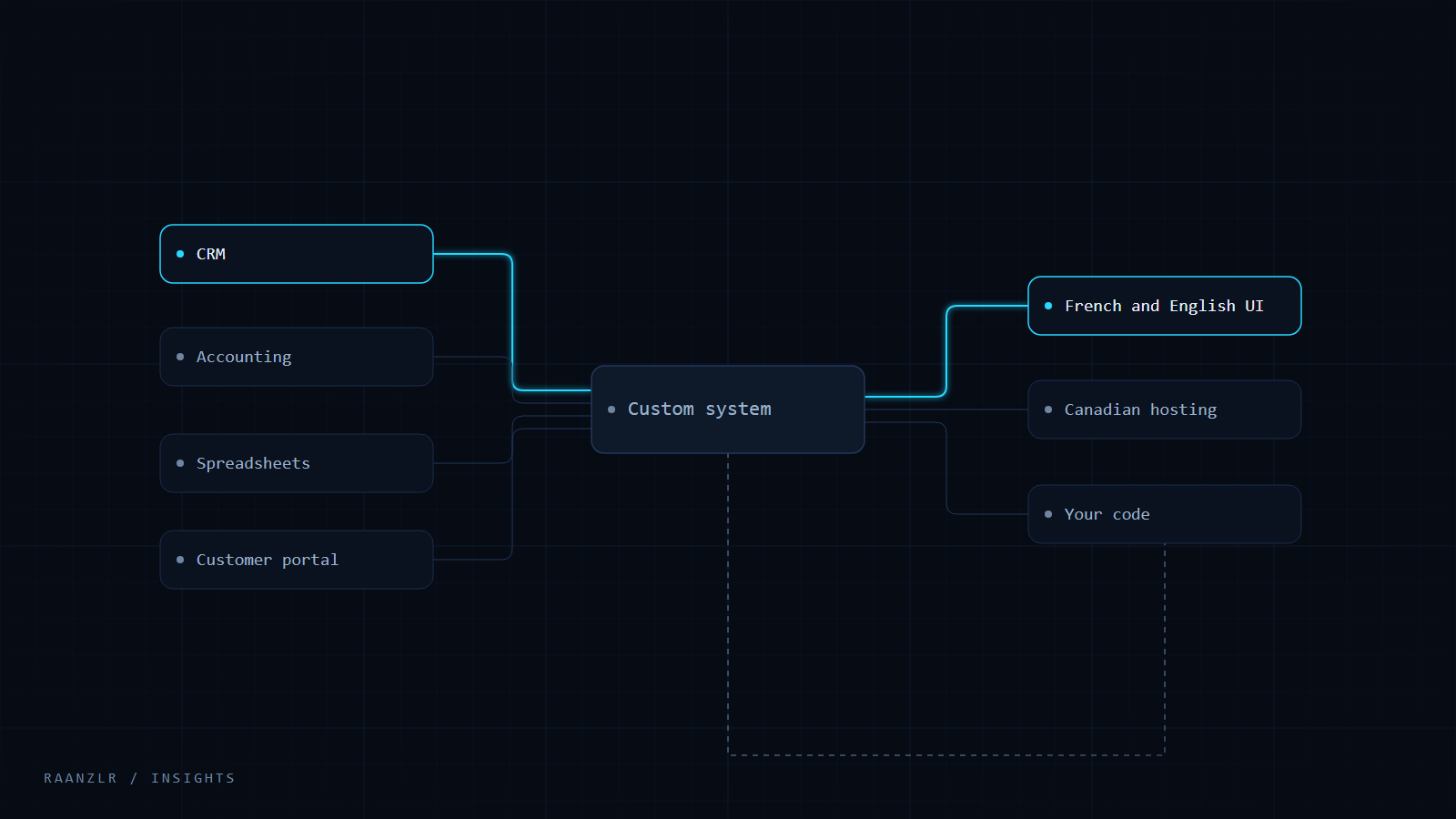
For Canadian companies the opening is in processes that cross several systems and still depend on someone copying data between them. Raanzlr can map one of those processes, measure what it costs today in staff hours and build the automation around it: workflow automation for approvals and handoffs, AI agents that answer from your own documents and pass edge cases to a person, and CRM and API integrations so each step writes back to the system of record. Dashboards can compare hours and error rates before and after. For teams in Canada, we can build in the notice and explanation steps that Quebec's Law 25 requires and the human review step that Bill C-36 proposes, with interfaces in English and French using French copy your team supplies.

10

References

// FAQ

How much do AI automation services cost for a Canadian business?
Price depends on how many systems the automation touches and how much human review the process needs, so a quote without a scoped process is a guess. A useful yardstick is staff time: the average hourly wage of Canadian employees was $37.89 in October 2026, according to Statistics Canada, before benefits and payroll costs. Ask for a fixed-scope pilot and compare its price with the hours it removes.
Do Canadian privacy laws apply to AI automation?
Yes, whenever the automation handles personal information. Quebec's Law 25 goes further for decisions made solely by automated processing. Since 22 September 2023 a business must tell the person, and on request share the information used and the main factors behind the decision. Routing tickets or drafting replies is rarely a decision about a person, but hiring and credit decisions are, so check those with counsel first.
Is there an AI law in Canada?
There is no dedicated one for private businesses. The Artificial Intelligence and Data Act died with Bill C-27 in January 2025. Bill C-36, introduced on 15 June 2026, would replace PIPEDA's private-sector rules and add an explanation right for automated decisions with legal or similarly significant effects, but it contains no standalone AI statute. It was still listed at second reading in the House of Commons on 24 November 2026.
Do small Canadian businesses use AI?
A growing minority do. In Statistics Canada's second-quarter 2026 survey, 19.9% of businesses with one to four employees had used AI in the past year, against 27.8% of those with 100 or more. Small users lean on data and text analytics and are much less likely to bring in outside help: 10.7% used consultants or vendors, compared with 30.2% of the largest users.

// Want to apply this?

Let's discuss how this applies to your business.

A senior engineer reviews every inquiry and responds within one business day.

Start a Conversation