Claude Fable 5.2 vs Opus 5.5: Is the New Model Worth Double for Business Automation?
AI Models7 min readNovember 17, 2026

Claude Fable 5.2 vs Opus 5.5: Is the New Model Worth Double for Business Automation?

Anthropic's Claude Fable 5.2 leads most of its launch benchmarks but costs twice as much as Opus 5.5. Here is when the upgrade pays off for business automation, and when the cheaper model is enough.

Is Claude Fable 5.2 worth it for business automation?

For most workflows, not yet. Claude Fable 5.2 costs $8 per million input tokens and $40 per million output tokens, double Claude Opus 5.5, and its lead on computer-use tests is small. It is worth paying for on long, multi-step agent runs where a failure is costly, which is where Anthropic reports its biggest gains. Test both models on real cases and compare the cost per completed task.

01

The short answer: keep Opus 5.5 as the default and use Fable 5.2 for the hardest jobs

For most business automation, Claude Opus 5.5 is still the better buy. Claude Fable 5.2, which Anthropic released on 9 November 2026, scores higher on most of the company's own tests, but it costs exactly twice as much per token: $8 per million input tokens and $40 per million output tokens, against $4 and $20 for Opus 5.5.

Fable 5.2 earns that price on long, multi-step work where a failed run is expensive, such as an agent that operates software through a screen for hours or a large code migration. Repetitive, well-defined jobs like ticket triage, invoice extraction, CRM updates and routine replies get most of the quality from Opus 5.5 or a cheaper model, for a fraction of the bill. Anthropic itself recommends starting with Opus 5.5 and moving up only when a task needs it.

Below are the prices, the benchmarks with their caveats, and four questions to settle the choice.
02

What Anthropic released on 9 November

Anthropic launched two versions of one model. Claude Fable 5.2 is the general release. It carries strong cybersecurity and biology safeguards, and Anthropic offers it to every API customer and paid Claude plan. Claude Mythos 5.2 is the same underlying model with some of those safeguards removed, and only vetted organizations in Anthropic's cyber and life sciences verification programs can use it.

For a business buyer, the practical details are these:

  • Where it runs: the Claude Platform under the model ID claude-fable-5-2, plus Amazon Web Services, Google Cloud and Microsoft Azure.
  • Context and output: a 1 million token context window and up to 128,000 output tokens, the same limits as Opus 5.5.
  • Fast mode: an optional setting that generates tokens up to 2.5 times faster at double the price, $16 input and $80 output per million tokens.
  • Lifespan: Anthropic's model docs say Fable 5.2 will not be retired before 9 November 2027. That matters if you are building a workflow you expect to run for a year.

One limit catches people out. Anthropic says Fable 5.2's safeguards will block most cybersecurity tasks, including penetration testing and exploit generation. A security operations team should confirm its tasks pass those filters before building an automation around the model.

03

What it costs next to the models you already use

Output tokens usually make up most of an agent's bill, because an agent writes a plan, tool calls and an answer on every step. On list prices, Fable 5.2 sits between Opus 5.5 and OpenAI's GPT-6 Astra.

  • Batch processing halves Fable 5.2's price to $4 input and $20 output per million tokens, the same as Opus 5.5 at standard rates.
  • Prompt caching cuts repeated input to $0.20 per million tokens for both Fable 5.2 and Opus 5.5, so an agent that rereads the same instructions and documents pays far less for input than the headline price suggests.

OpenAI's lineup gives a cheaper reference point. GPT-6.1 Sol lists at $2 input and $10 output, and OpenAI describes it as near-Astra performance at a lower cost. We did not find comparable published benchmark scores for it, so it appears in the price chart and the table but not in the benchmark chart.

API output price per million tokens (USD, standard rate)

Source: [Anthropic, Claude API pricing](https://platform.claude.com/docs/en/about-claude/pricing) and [OpenAI, API pricing](https://developers.openai.com/api/docs/pricing), both checked 17 November 2026. Haiku 5.5 price is for prompts up to 100,000 tokens.

04

Benchmarks: Fable 5.2 leads most tests, with one notable exception

Every figure in this chart comes from Anthropic's launch post, so treat it as vendor-reported. Anthropic ran its models with safeguards on and at their highest available effort setting, and it points to the system card for methodology.

Four results matter most for automation work:

  • AutomationBench (business workflows): Fable 5.2 scores 51.4%, up from 42.5% for Opus 5.5. The same table puts Google's Gemini 4 Carbon ahead of both at 53.9%, so Fable 5.2 is not the top model on Anthropic's own business workflow test.
  • OSWorld 2.1 (computer use): 89.3% against 87.2% for Opus 5.5. The gap is small, so Opus 5.5 is already a strong choice for agents that click through web apps and desktop software.
  • Remote Labor Index (knowledge work): 41.3% at high effort against 21.3% for Opus 5.5. This is the largest jump in the table, and the test closest to the long, open-ended work a company might hand to an agent.
  • AA-Briefcase (knowledge work rubric): 66.1% against 61.2%.

For an independent check, the Artificial Analysis Intelligence Index (version 5.0.1, November 2026) ranks Claude Fable 5.2 at maximum effort first with 65 points, ahead of Gemini 4 Carbon at 60 and Claude Opus 5.5 at 59. That matches the direction of Anthropic's numbers, although an index score tells you nothing about your particular workflow.

Selected launch benchmarks, vendor-reported (%)

Source: Anthropic, Introducing Claude Fable 5.2 and Claude Mythos 5.2, 9 November 2026. Vendor-reported; highest available effort, Anthropic models with safeguards on.

05

Side by side: four models for business automation

The table puts the main options in one place. We highlight Claude Opus 5.5 because it is the sensible default for most business automation: it costs half as much as Fable 5.2, and its computer use and knowledge work scores are close. Move a workflow to Fable 5.2 when testing shows Opus 5.5 failing on it, and not simply because a newer model exists.

The benchmark rows come from Anthropic's comparison, and OpenAI's prices and context limits come from its API pages. For more background on the older pair, see our comparison of Opus 5.5 and GPT-6 Astra.

Claude Fable 5.2, Opus 5.5 and OpenAI's options compared
Claude Fable 5.2Claude Opus 5.5GPT-6 AstraGPT-6.1 Sol
API price per 1M tokens (input / output)$8 / $40$4 / $20$10 / $50$2 / $10
Batch price per 1M tokens (input / output)$4 / $20$2 / $10$5 / $25$1 / $5
Context window1M tokens1M tokens1.05M tokens1.05M tokens
AutomationBench (vendor-reported)51.4%42.5%41.4%Not reported
OSWorld 2.1 computer use (vendor-reported)89.3%87.2%79.5%Not reported
Best suited toLong multi-step agent runs and code migrationsDefault for most agents and workflowsTeams already standardized on OpenAIHigh-volume work on a tight budget

Source: Anthropic launch post and Claude API pricing, November 2026; OpenAI API pricing and models pages, checked 17 November 2026. OpenAI batch prices are 50% of standard.

06

Price per token is not cost per task

Anthropic's launch post makes a point that is easy to miss: Fable 5.2 often reaches the same result with less effort. Several of its claims are about cost per task rather than cost per token, and all of them are vendor-reported:

  • On FrontierCode 2.0 at high effort, Fable 5.2 scores 45.3% against 45.5% for Opus 5.5 at its best, for roughly half the cost per task.
  • On the WANDR agentic search test, Fable 5.2 at medium effort matches Opus 5.5's top score for about 40% of the cost per task.

Anthropic makes a bigger claim for Humanity's Last Exam, where it says Fable 5.2 at low effort matches Opus 5.5's top score for less than a tenth of the cost per task.

If those results hold on your workload, Fable 5.2 at a lower effort setting could cost less than Opus 5.5 at its highest. Treat that as something to test. The right measure is the cost of a completed, correct task: total tokens spent, including retries and failed runs, divided by the number of tasks that passed review. Run the same 50 to 100 real cases through both models and compare that number.

07

How to decide: four questions before you switch

1. How long is the task?

Short, single-step jobs, such as classifying an email or pulling fields from an invoice, rarely benefit. Anthropic's own results show the biggest gaps on long chains of tool calls and runs that last hours.

2. What does a failure cost?

If a wrong answer goes to a human reviewer anyway, the cheaper model is usually fine. If a failed run means a broken deployment or a missed filing deadline, paying more per task can work out cheaper.

3. How many runs a month?

At high volume, the doubled price adds up quickly. Route easy cases to Sonnet 5.5 or Haiku 5.5 and send only the hard ones to Fable 5.2.

4. Does the task touch security work or sensitive data?

Fable 5.2's safeguards may block security tasks. For data rules, its availability on AWS, Google Cloud and Azure lets you use cloud accounts and contracts you already have, but check which regions offer the model before you commit. Anthropic is also testing Enterprise Frontier Safeguards in a private beta, which it says is compatible with zero data retention.

08

What this means for business automation

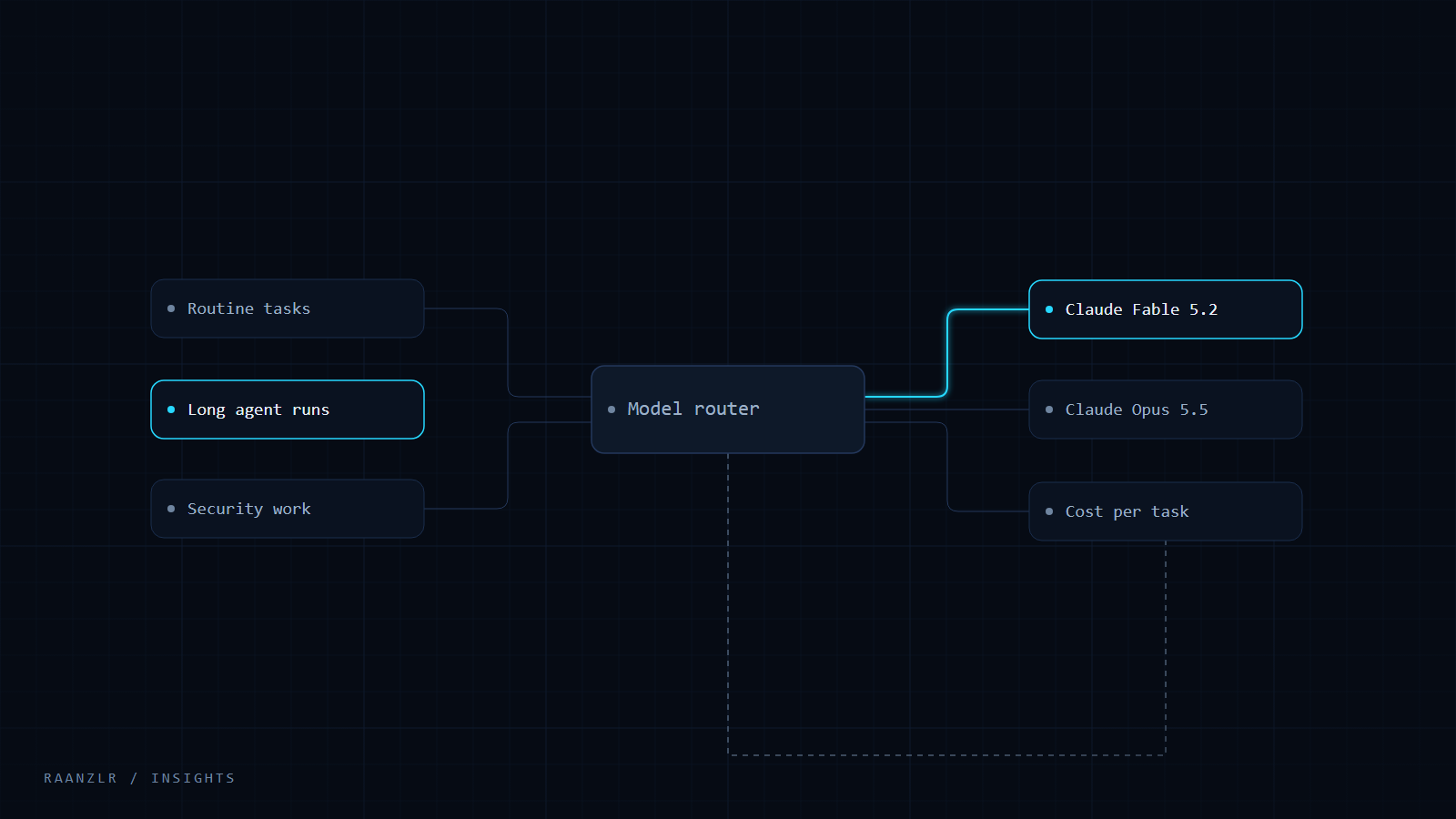
Releases like this one are a good reason to build automation that can switch models without a rewrite. Raanzlr builds AI agents and workflow automation with a routing layer that sends each task to the cheapest model that handles it reliably and escalates hard cases to a stronger one such as Fable 5.2. We can also set up the evaluation step described above: a test set built from your real cases, and a report comparing the cost of each completed task across models. For document-heavy work we build custom AI systems, and dashboards that track model spend by workflow. We work remotely with companies in the United States, Canada, Saudi Arabia and the UAE.

// FAQ

Is Claude Fable 5.2 better than Claude Opus 5.5?
On most of Anthropic's published benchmarks, yes. Fable 5.2 leads Opus 5.5 on coding, computer use, knowledge work and business workflow tests, and Artificial Analysis ranks it first on its Intelligence Index with 65 points against 59 for Opus 5.5. It also costs twice as much per token. For short, routine tasks the quality gap rarely justifies the price, so test it on your own work first.
How much does Claude Fable 5.2 cost?
Through the API, Fable 5.2 costs $8 per million input tokens and $40 per million output tokens. Batch processing halves that to $4 and $20, and cached input costs $0.20 per million tokens. An optional fast mode, up to 2.5 times faster, costs $16 and $80. On Claude Pro plans and standard Team seats, Fable can use up to half of the weekly usage limit.
What is the difference between Claude Fable 5.2 and Claude Mythos 5.2?
They are the same underlying model. Fable 5.2 ships with strong cybersecurity and biology safeguards, which lets Anthropic offer it to all customers. Mythos 5.2 has some of those safeguards removed and is limited to vetted organizations in Anthropic's cyber and life sciences verification programs. Most businesses will use Fable 5.2, but its safeguards block most cybersecurity tasks, so security teams should check their use case first.
Should we switch our existing automations to Fable 5.2?
Not across the board. Keep working automations on the model that already passes your tests, and trial Fable 5.2 only on the tasks where the current model fails or needs many retries. Measure cost per completed task, not price per token, because Anthropic reports that Fable 5.2 can match Opus 5.5 at lower effort settings. Then route only the hard cases to it.

// Want to apply this?

Let's discuss how this applies to your business.

A senior engineer reviews every inquiry and responds within one business day.

Start a Conversation