What Is AI Automation for Business? A Plain Guide for 2026
Automation7 min readOctober 2, 2026

What Is AI Automation for Business? A Plain Guide for 2026

AI automation hands software the routine work that used to need a person's judgement: reading documents, answering customers, sorting requests. Here is what it is, how it differs from older automation, and where US and Canadian firms stand in 2026.

What is AI automation for business?

AI automation is software that completes business tasks which involve reading, writing or judgement, such as classifying emails, extracting invoice data or answering customer questions, and then acts inside your existing systems. Unlike rules-based automation, it copes with messy inputs. It works best on high-volume, repetitive tasks where a person still reviews the cases the system is unsure about.

01

The short answer: AI automation lets software do work that needs judgement

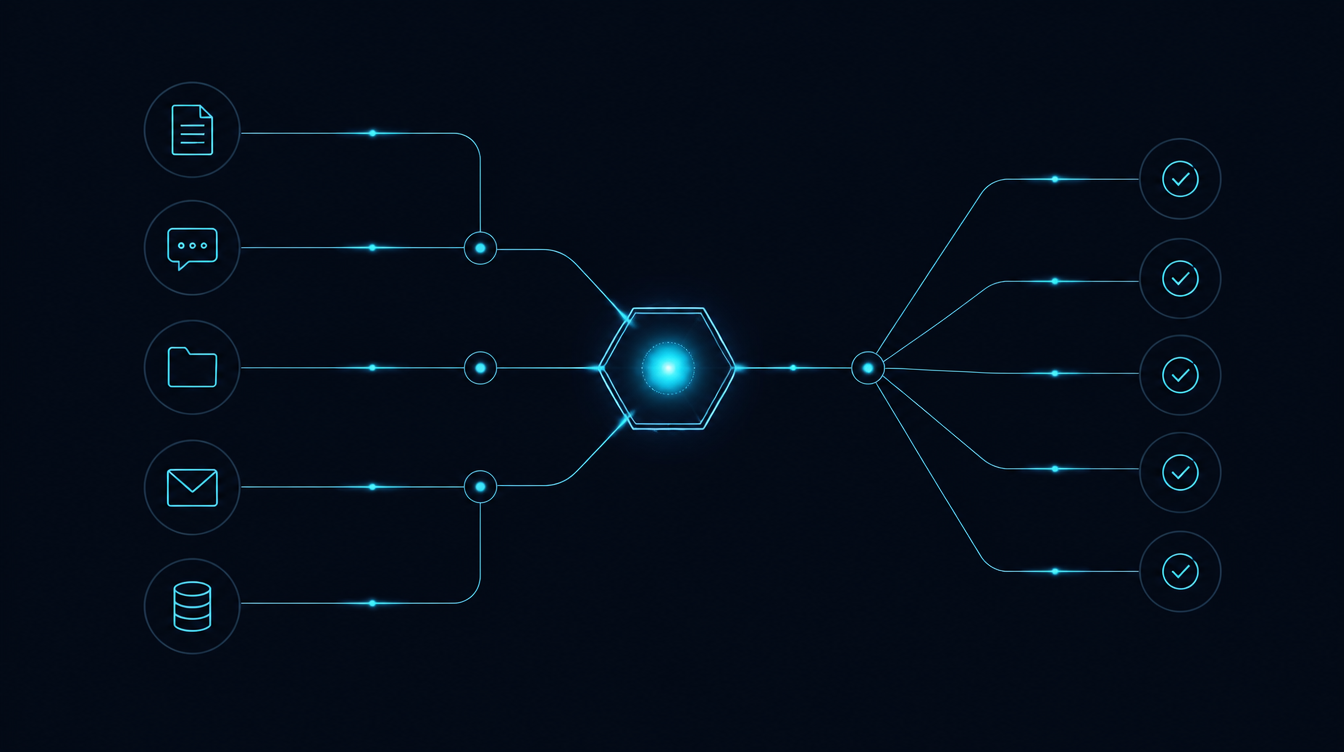
Illustration: documents, chats, files, email and database records flow into one AI step, which routes each item to a completed task.

AI automation is the use of AI models, usually large language models, to complete business tasks that involve reading, writing or deciding, and then act on the result inside the tools a company already uses. It sorts an inbox, pulls the totals out of a supplier invoice, answers a customer's delivery question or drafts the follow-up email, and passes anything uncertain to a person.

That is the difference from the automation most companies already run. Classic automation follows fixed rules: if a form field says X, do Y. It is reliable, but it stops the moment the input is messy, and most business input is messy. A customer writes in a run-on sentence, a supplier changes its invoice layout, a contract arrives as a scanned PDF. AI automation was built for exactly those cases.

The idea is not new, but the economics changed. Language models that can read a document and return structured data are now cheap enough to run on every email or ticket, which is why adoption has moved from large enterprises into mid-sized firms over the last two years.

02

How AI automation differs from rules, RPA and agents

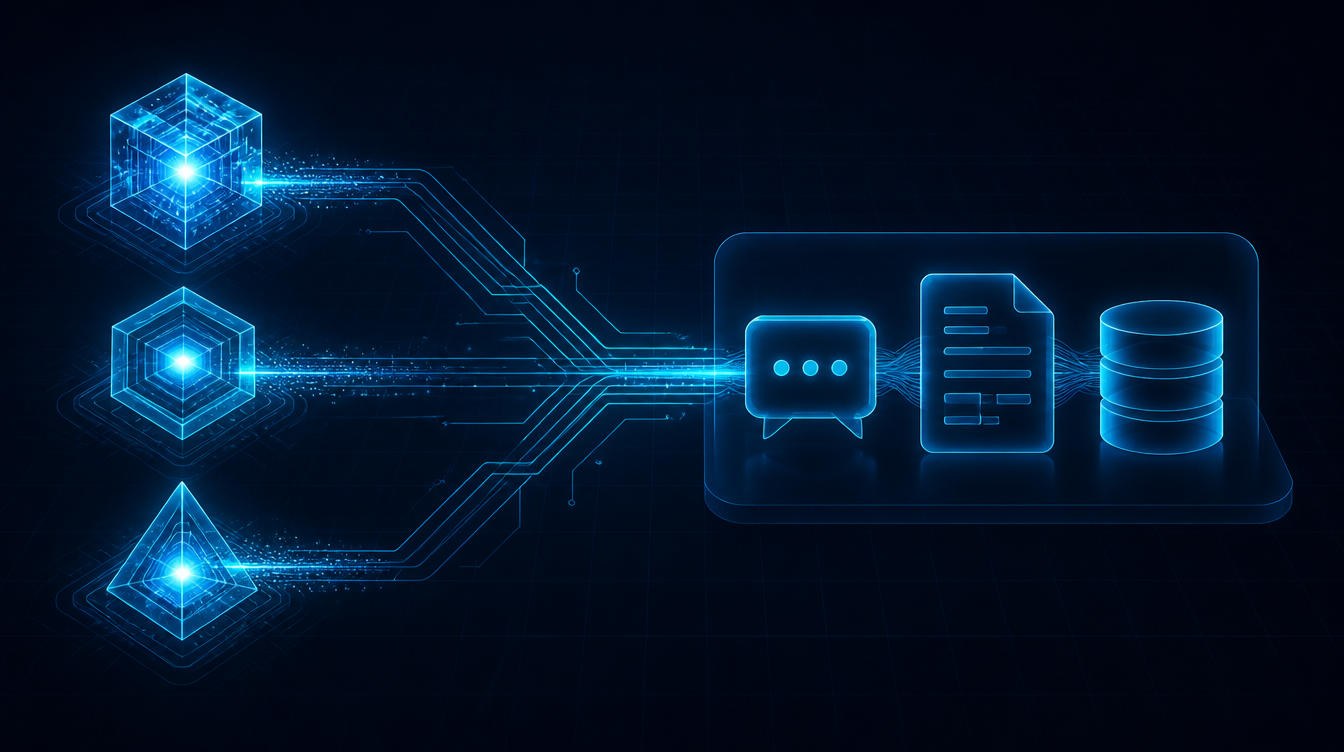
Illustration: a fixed conveyor moves identical items in a straight line, while an AI step reads irregular items and routes each to the right lane.

Three terms get mixed up in sales pitches. They are layers, not rivals, and a sound system often uses more than one.

  • Rules-based workflow automation connects apps with fixed triggers and actions. Tools such as Zapier, Make, n8n or Power Automate live here.
  • AI automation adds a model at the steps that need understanding: classify this request, extract these fields, draft this reply. The workflow around it stays predictable.
  • AI agents go further. An agent is given a goal and a set of tools, decides its own steps, calls systems, checks results and tries again. That flexibility is useful for open-ended work, and it is also where cost and risk climb.

For most first projects the middle column is the right choice. It gets the benefit of language understanding while keeping every action inside a workflow you can log, test and explain to an auditor. Agents earn their place once a process has many branches that are hard to write down as rules.

Three layers of business automation
Rules-based / RPAAI automationAI agents
Handles messy inputNoYesYes
Who decides the stepsYou, in advanceYou, with AI at chosen stepsThe agent, within limits you set
PredictabilityHighHigh around the AI stepLower; needs monitoring
Typical taskCopy form data into a CRMRead an invoice and post itResolve a support case across systems
Best first useStable, structured processesHigh-volume text and documentsMulti-step work with many branches

Source: Raanzlr editorial comparison, October 2026

03

What businesses actually automate with AI

The most useful public data on this comes from national statistics offices, because they survey ordinary firms rather than AI enthusiasts. Statistics Canada asked businesses that use AI what they use it for. In the second quarter of 2026 the top three answers were data analytics, text analytics and virtual agents or chatbots.

In practice those categories map to a short list of recurring jobs:

  • Customer conversations: answering order, booking and policy questions on the website or WhatsApp, and handing complex cases to staff with the history attached.
  • Documents: reading invoices, purchase orders, contracts and claims, extracting fields, and posting them to accounting or ERP systems.
  • Inbound triage: classifying emails and tickets by topic and urgency, then routing them to the right queue.
  • Reporting: pulling numbers from several systems into one summary, and explaining in plain language what changed.
  • Knowledge lookup: letting staff ask questions of internal policies and manuals with answers that cite the source document.

None of these remove the need for people. They remove the copying, re-typing and searching that fill a large part of many office jobs.

Top uses among Canadian businesses using AI, Q2 2026 (%)

Source: [Statistics Canada, The Daily: Canadian Survey on Business Conditions, second quarter 2026](https://www150.statcan.gc.ca/n1/daily-quotidien/260527/dq260527a-eng.htm), 27 May 2026. Official survey.

04

How many US companies use AI in 2026

Headlines often say that almost every company now uses AI. That depends on who you ask. McKinsey's global survey, published in November 2025 and based on 1,993 respondents, found 88% of organisations use AI regularly in at least one business function. Its sample leans towards larger companies.

The US Census Bureau measures something narrower: whether a firm used AI in any business function in the previous two weeks, across businesses of every size. Between December 2025 and early May 2026 that figure sat between 17% and 20%, reaching 19.8% in the period ending 3 May 2026. Between 20% and 23% of firms expected to be using AI within six months.

The gap by sector and size is wide. Information firms and finance and insurance firms lead, retail trails, and 37% of firms with 250 or more employees reported AI use compared with under 20% of the smallest firms.

What that means for a mid-sized company

If you are a 50-person distributor or clinic group in the US and have not automated anything with AI yet, you are in the majority, not behind. The firms that have moved are mostly larger ones in information and finance, and they are learning in public which processes pay back first.

US firms using AI in any business function, by sector, period ending 3 May 2026 (%)

Source: [US Census Bureau: Large Firms With at Least 20 Employees Biggest AI Users](https://www.census.gov/library/stories/2026/05/ai-use-businesses.html), 26 May 2026, Business Trends and Outlook Survey. Official survey.

05

Canada's adoption has tripled in two years

Canada started slower and is catching up fast. In Statistics Canada's quarterly business survey, the share of businesses that used AI to produce goods or deliver services over the previous 12 months went from 6.1% in the second quarter of 2024 to 12.2% a year later and 19.2% in the second quarter of 2026.

The same survey shows why the rest have not moved. Two in five businesses (40.0%) said AI is not relevant to what they produce. Among the barriers named, cybersecurity and privacy concerns came first at 13.4%, ahead of cost at 10.6%.

Those two answers are worth taking seriously. Saying AI is not relevant often means the owner pictures a chatbot rather than the invoice and inbox work described above. Privacy concerns are legitimate, especially for clinics, law firms and financial advisers, and they are a design question: where the data is processed, what the model is allowed to see, and what is logged.

Canadian businesses using AI to produce goods or deliver services (%)

Source: [Statistics Canada, The Daily: Canadian Survey on Business Conditions, second quarter 2026](https://www150.statcan.gc.ca/n1/daily-quotidien/260527/dq260527a-eng.htm), 27 May 2026. Official survey.

06

Where AI automation goes wrong

Using AI and getting value from it are different things. In the same McKinsey survey, 62% of respondents said their organisation was at least experimenting with AI agents, but only 23% were scaling an agentic system anywhere in the business. About 39% reported any impact on enterprise-level earnings from AI, and most of those put it under 5%.

Gartner was blunter. In June 2025 it predicted that over 40% of agentic AI projects will be cancelled by the end of 2027, citing rising costs, unclear business value and weak risk controls. It also warned about agent washing: vendors relabelling chatbots and RPA tools as agents.

The failures tend to share a few causes:

  • No baseline. Nobody measured how long the task took before, so nobody can show it improved.
  • Too wide a scope. The project tries to automate a whole department instead of one process.
  • No human checkpoint. The system acts on low-confidence answers instead of routing them to a person.
  • Disconnected data. The model cannot see the CRM, ERP or document store it needs, so staff copy data in by hand and the saving disappears.

McKinsey's small group of high performers, about 6% of respondents, stood out mainly for redesigning workflows around AI rather than adding it on top of old ones.

07

How to start: a practical sequence

A first AI automation project does not need a strategy deck. It needs one well-chosen process and a way to measure it.

  • Pick one process. Choose something frequent, repetitive and text-heavy, where a mistake is caught before it reaches a customer. Inbound email triage and invoice entry are common choices.
  • Measure it as it is. Record volume, handling time and error rate for two to four weeks.
  • Map the systems. List where the input arrives, where the output must go, and who approves exceptions. Most of the build effort is in these connections, not in the model.
  • Build with a review step. Let the system handle the cases it is confident about and queue the rest for a person. Lower the review rate only as the logs show it is safe.
  • Compare and decide. After a few weeks, compare against the baseline. Expand to the next process only if the first one paid back.

This is slower than a demo, and it is the approach that survives contact with real data.

08

What this means for business automation

For a US or Canadian company weighing its first project, the useful question is which single process to automate, with what review step, connected to which systems. Raanzlr designs and builds that layer. We can build workflow automation that reads emails and documents and posts the results into your tools, AI agents that answer customers on your site or WhatsApp and hand off to staff, and CRM and API integrations so the AI sees the data it needs. For policy and manual lookup we build document AI that cites its sources, and dashboards to track the baseline against the result. We work with companies in the United States and Canada.

// FAQ

Is AI automation the same as RPA?
No. Robotic process automation (RPA) repeats fixed clicks and keystrokes and breaks when a screen or format changes. AI automation reads unstructured inputs such as emails, PDFs and chat messages, decides what they mean, and then triggers the next step. Many practical systems combine both: AI handles the reading and deciding, while rules or RPA handle the predictable, auditable steps that follow.
What should a business automate first with AI?
Start with one process that is frequent, repetitive and easy to measure, where a wrong answer is cheap to catch. Typical first candidates are sorting inbound requests, extracting data from documents, answering common customer questions and drafting routine replies. Measure the current handling time and error rate before you build, so you can judge the result honestly afterwards.
Do AI agents replace employees?
In most current deployments they take over parts of tasks rather than whole jobs. Agents handle the repetitive steps and pass exceptions, approvals and sensitive decisions to a person. Gartner's 2025 forecast that over 40% of agentic AI projects will be cancelled by the end of 2027 is a reminder that agents without clear scope, cost control and human oversight tend to fail.

// Want to apply this?

Let's discuss how this applies to your business.

A senior engineer reviews every inquiry and responds within one business day.

Start a Conversation