Gemini 4 Argon vs Claude Opus 5.5 and GPT-6 Astra: Is It Worth Switching for Business Automation?
AI Models7 min readOctober 18, 2026

Gemini 4 Argon vs Claude Opus 5.5 and GPT-6 Astra: Is It Worth Switching for Business Automation?

Google's Gemini 4 Argon went on general sale on 13 October 2026 with the top score on AutomationBench and the lowest cost per task, until its price doubles on 1 December. Here is what that means for real workflows.

Is Gemini 4 Argon better than Claude Opus 5.5 for business automation?

It depends on the measure. Google's own tests put Gemini 4 Argon ahead on business benchmarks such as AutomationBench, 51.3% against 42.5%. Independent testing by Artificial Analysis still ranks Claude Opus 5.5 higher overall, 58 against 53 on its Intelligence Index. Argon is cheaper per task until 30 November 2026, so test both on your own workflow.

01

The short answer: test Argon now, but don't rebuild around it
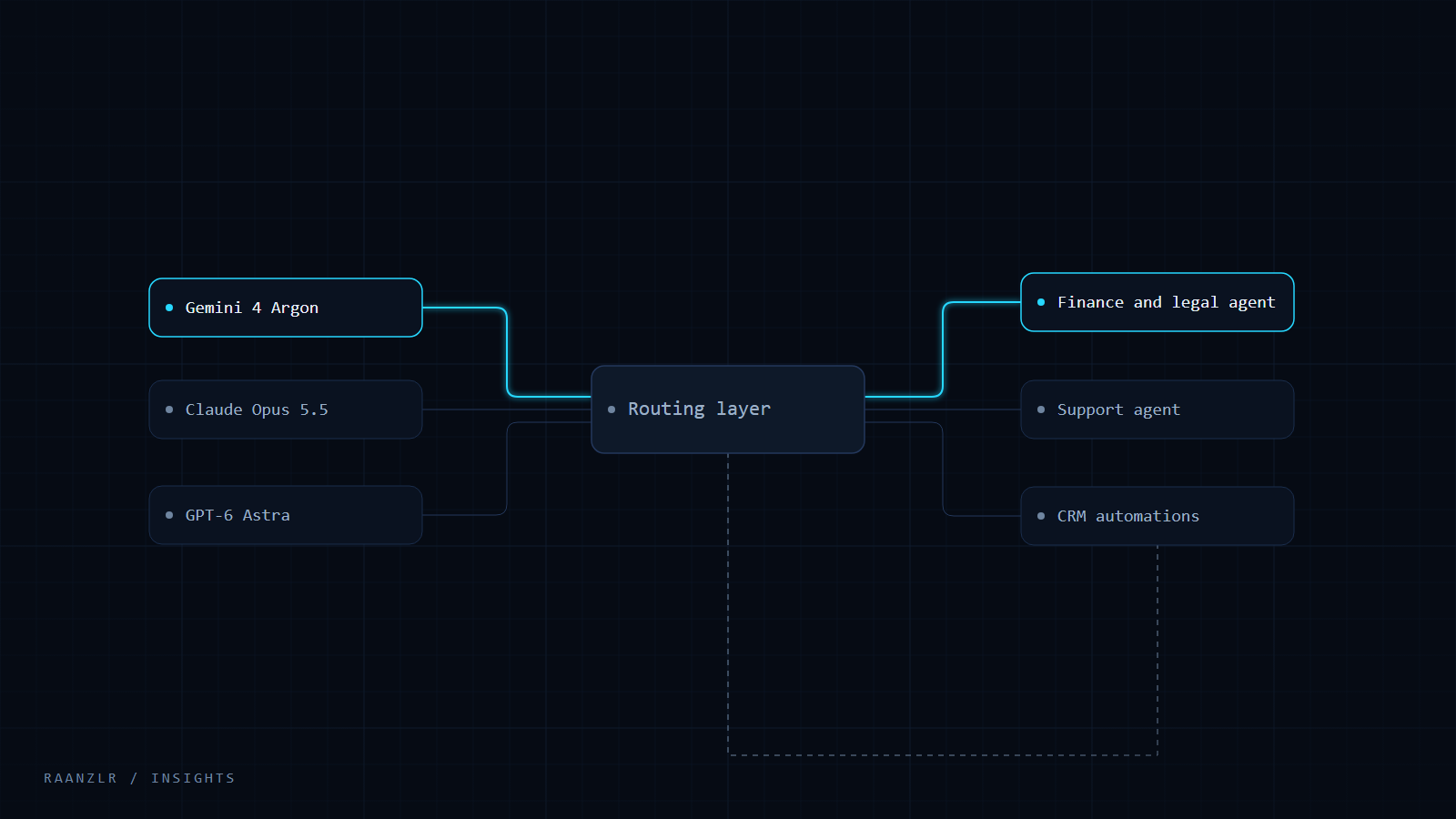
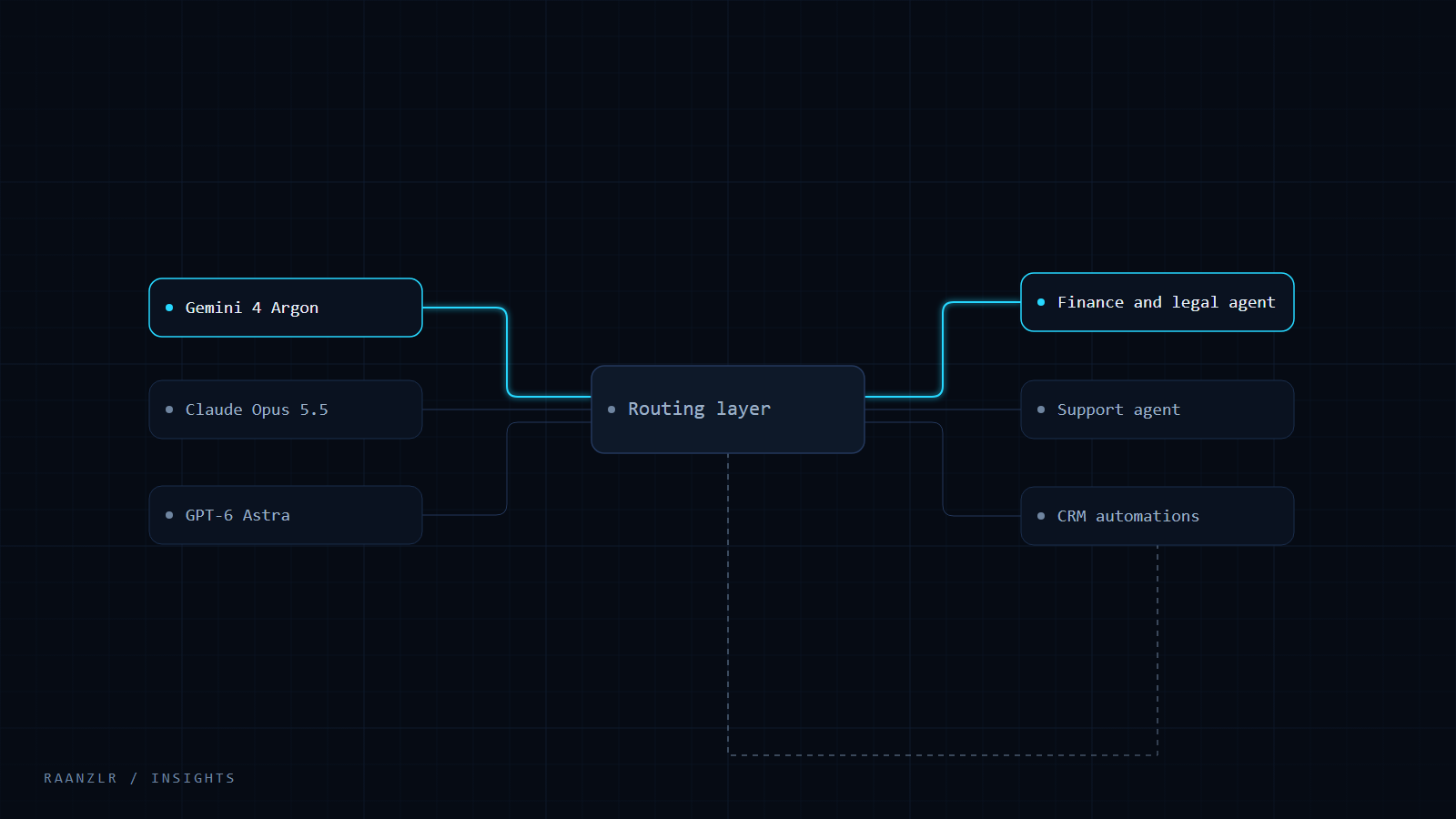
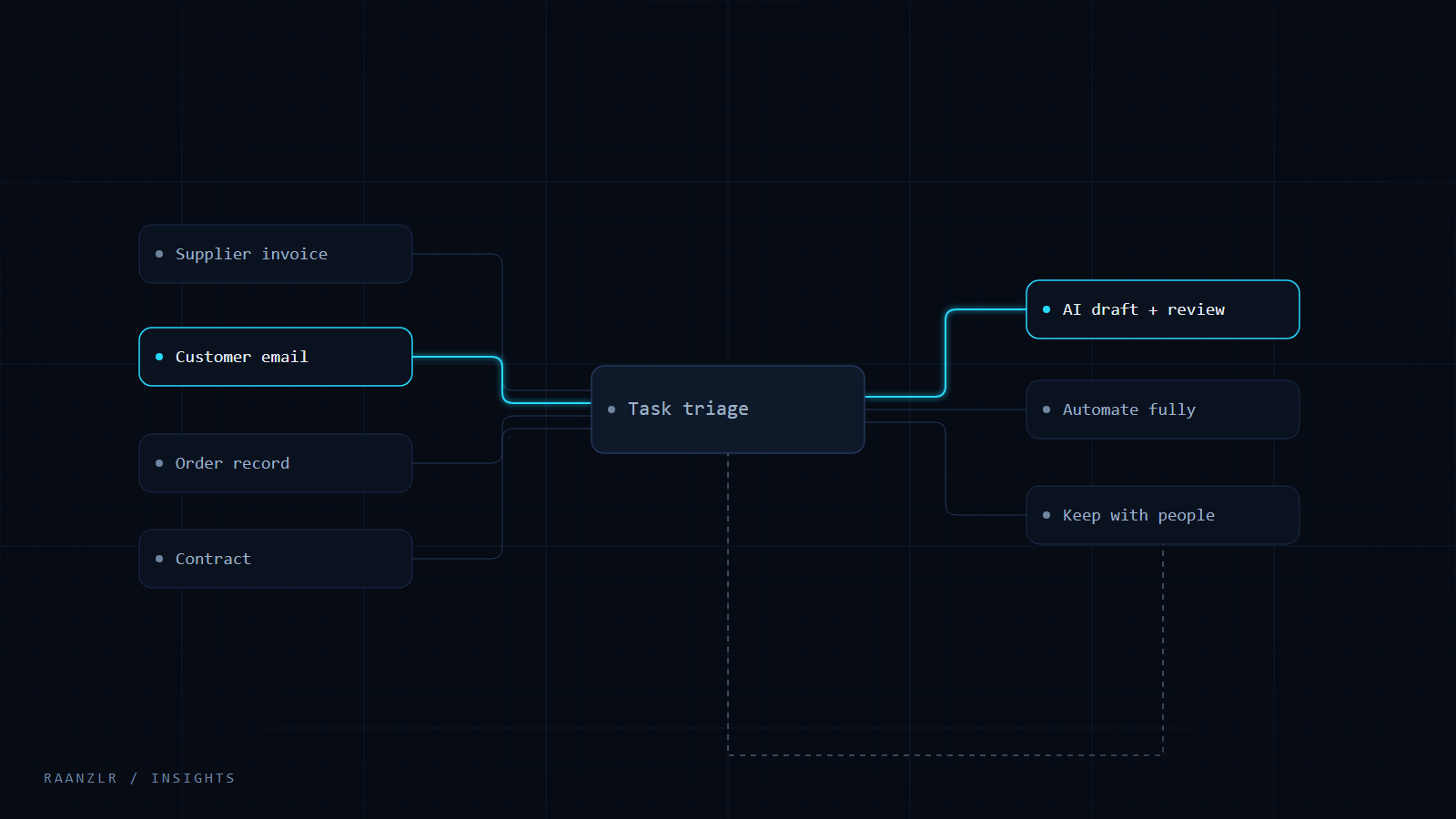
Three frontier models behind one routing layer: the practical question is which workflow step each one should run.

Gemini 4 Argon is worth testing this month for any business that runs document-heavy automation, especially in finance and legal work, because Google's own benchmarks put it first on business tasks and its introductory price makes it the cheapest frontier model per task. It is not a clear overall winner. Independent testing still ranks Claude Opus 5.5 higher, and Argon's price doubles on 1 December 2026.

Google announced Argon on 30 September and opened it to everyone on 13 October, three weeks after Anthropic released Claude Opus 5.5 and a few weeks after OpenAI's GPT-6 Astra. That makes three frontier models from three vendors in about a month, each claiming a lead somewhere.

This article compares the three on price, on the benchmarks each vendor published, and on what an independent tester measured. Every figure links to its source, and we flag which numbers come from a vendor and which from a third party. We compared Claude Opus 5.5 and GPT-6 Astra in more detail in our September comparison; this piece focuses on what Argon changes.
02

What Google shipped on 13 October

Argon reached general availability after a two-week head start for security teams in Google's Fairwind programme, which gives governments, hospitals and telecom operators early access to new models. For a business buyer, these are the details that matter:

  • Price: $2 per million input tokens and $10 per million output tokens until 30 November 2026, then $4 and $20. Cached input is $0.10 per million, rising to $0.20, and the batch tier costs half.
  • Context: a 1,048,576-token limit shared by input, reasoning and output. The default maximum answer is 65,536 tokens, with longer output available for background jobs.
  • Features: function calling, structured output, file search, search grounding, code execution, and computer use in preview. Input can be text, images, audio, video or PDF; output is text only.
  • Where to buy it: the paid Gemini API and Google Cloud, Google AI Pro and Ultra subscriptions, and Gemini for business customers. It is not on the free API tier.
  • Knowledge cutoff: March 2026, according to the model card.

One detail is easy to miss. Argon offers low, medium and high thinking levels, and the independent scores below were measured at high. TechTimes reported on 15 October that subscribers get medium by default, so a quick test in the Gemini app may not reflect the published numbers. In an API integration you set the level yourself.

03

Price and positioning side by side

At its introductory rate, Argon costs half of Claude Opus 5.5 per token and a fifth of GPT-6 Astra. From 1 December it matches Opus 5.5 exactly on list price, at $4 and $20, and on cached input at $0.20 per million tokens.

We highlight Argon below because, for a team starting a document-heavy automation project this quarter, it combines the top vendor score on business tasks with the lowest measured cost per task. Plan around the standard price, though, not the introductory one. The last row is our editorial reading of where each model fits, not a benchmark result.

Three frontier models at a glance, October 2026
Gemini 4 ArgonClaude Opus 5.5GPT-6 Astra
Generally available13 Oct 202622 Sep 2026September 2026
Input, per 1M tokens$2 until 30 Nov 2026, then $4$4$10
Output, per 1M tokens$10 until 30 Nov 2026, then $20$20$50
Cached input, per 1M tokens$0.10, then $0.20$0.20$1.00
Where it fitsLong documents, finance and legal agents, budget-sensitive pilotsLong multi-step agent work; highest independent overall scoreTeams already on OpenAI; fast answers with fewer tokens

Source: Published API list prices from Google (Gemini API pricing, October 2026), Anthropic and OpenAI (September 2026)

04

Google's benchmarks: a big lead on business tasks

The Argon model card compares it with GPT-6 Astra, Claude Opus 5.5 and Claude Fable 5.1 on benchmarks Google chose. These are vendor-reported figures, measured by Google, including the scores it gives its competitors.

The results lean towards work businesses actually pay for. Argon scores 51.3% on AutomationBench, Zapier's test of end-to-end tasks across business functions, against 42.5% for Opus 5.5 and 41.4% for GPT-6 Astra. On Vals Finance Agent v2 it reaches 65.4%, against 58.6% and 53.5%. On the Vals Index, which covers finance, coding, legal and tax work, the gap is narrower: 68.9% against 67.0% for Opus 5.5.

Two cautions. First, harness choices move these numbers. Anthropic's own launch table put Opus 5.5 at 40.0% on AutomationBench, while Google's table puts it at 42.5%. Second, a vendor picks the tests it publishes. Google's card leaves out terminal benchmarks, and the independent results in the next section show Argon behind both rivals on Terminal-Bench 4.0.

Business benchmarks, measured and reported by Google (%)

Source: Google DeepMind, Gemini 4 Argon model card, 13 October 2026. Vendor-reported.

05

Independent testing: level with GPT-6 Astra, behind Opus 5.5

Artificial Analysis runs the same ten evaluations on every model under the same conditions. Its Intelligence Index puts Argon at high effort on 53, level with GPT-6 Astra and five points behind Claude Opus 5.5 at 58. The tester describes it as Google's return to the top three labs, which is a strong result, but it is not a lead.

The detail is more useful than the headline:

  • Business tasks: Argon ranks first on the tester's own AutomationBench-AA run at 78%, seven points ahead of Claude Sonnet 5.5. This is the independent result that best supports Google's claim.
  • Terminal work: on Terminal-Bench 4.0 it scores 57%, behind Opus 5.5 at 60% and GPT-6 Astra at 59%.
  • Hallucination: on AA-Omniscience it has a 15% hallucination rate, the lowest among leading models, meaning it more often declines rather than inventing an answer. Its accuracy on the same test, 50%, is 13 points below GPT-6 Astra.

For automation, a low hallucination rate matters. A model that says it doesn't know is easier to build safe hand-offs around than one that answers confidently and wrongly.

Artificial Analysis Intelligence Index

Source: Artificial Analysis, 22 and 30 September 2026 (independent testing)

06

The token bill: cheap now, less so in December

Per-token price is only half of what you pay. The other half is how many tokens a model writes to finish a task, and here the three differ a lot. On the Intelligence Index, Artificial Analysis counted about 62,000 output tokens per task for Argon, about 27,000 for GPT-6 Astra and about 119,000 for Opus 5.5 at maximum effort.

Combine the two and Argon at its introductory price cost $1.99 per index task, against $3.26 for GPT-6 Astra. At the standard price from 1 December, the same token use works out at about $3.98 per task, which is more than GPT-6 Astra. Artificial Analysis did not publish a per-task cost for Opus 5.5 in these articles, so we leave it out of the chart rather than estimate it.

Three practical points follow:

  • Price your pilot at $4 and $20. A business case that only works at the introductory rate has about six weeks to live.
  • Use the batch tier for back-office work. Overnight document processing at half price changes the comparison.
  • Set the thinking level per step. High effort on every call is the fastest way to multiply the token count.
Cost per Intelligence Index task (US$)

Source: [Artificial Analysis, Gemini 4 Argon](https://artificialanalysis.ai/articles/gemini-4-argon-google-top-three-labs), 30 September 2026 (independent testing; the 1 December figure applies Google's standard price to the same token use)

07

Which model for which workflow

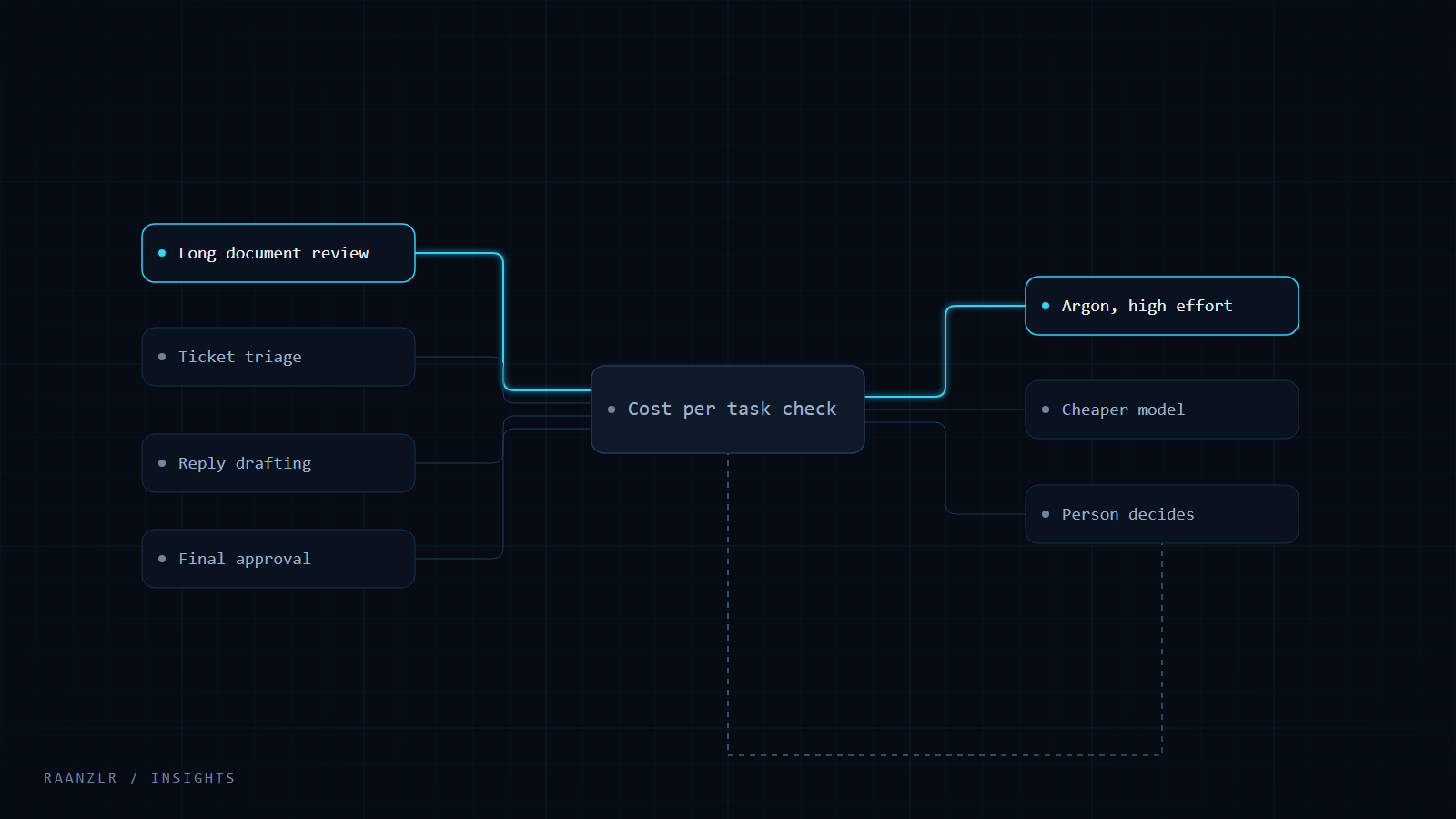
A cost check per task decides which step runs on Argon at high effort, which goes to a cheaper model, and which stays with a person.

No single model wins every step, and the ranking has changed three times since September. The useful question is which model each step should run on.

Document-heavy finance and legal work

Reviewing contracts, reconciling statements or answering questions across a long policy pack plays to Argon's strengths: the top vendor scores on finance and legal agent benchmarks, a strong long-context retrieval score on GraphWalks, and a low hallucination rate. It is a sensible first candidate for a finance or legal pilot.

Long, multi-step agents

A support or sales agent that plans, calls several tools and recovers from errors is still where Opus 5.5 has the strongest independent record, including the higher Terminal-Bench 4.0 score. If yours already works well on Opus 5.5, a few points on a vendor table is not a reason to move it.

Teams already on OpenAI

GPT-6 Astra writes far fewer tokens per task, which helps response time, and switching cost is real once a model has passed your security review.

Arabic and bilingual work

None of these benchmarks measures Gulf dialects or messages that mix Arabic and English. Test each candidate on a few hundred real customer messages before you decide.

08

What this means for business automation

Argon is a good reason to keep automation independent of any single model. Raanzlr builds document AI and RAG systems and workflow automation with a routing layer between your systems and the model, so a contract-review step can run on Argon while a support agent stays on Opus 5.5, and either can change when prices move on 1 December. Before anything goes live, we run the candidate models side by side on a sample of your own documents and messages in English and Arabic, and compare accuracy and cost per completed task. AI agents built this way are delivered remotely for companies in the United States and the UAE.

// FAQ

How much does Gemini 4 Argon cost?
On the Gemini API, Gemini 4 Argon costs $2 per million input tokens and $10 per million output tokens until 30 November 2026. From 1 December the rates double to $4 and $20. Cached input is $0.10 per million tokens, rising to $0.20, and the batch tier is half price. It is not available on the free API tier.
Is Gemini 4 Argon cheaper than GPT-6 Astra?
For now, yes. Artificial Analysis measured $1.99 per Intelligence Index task for Argon at the introductory price, against $3.26 for GPT-6 Astra. At Google's standard price from 1 December, the same work would cost about $3.98 per task, because Argon writes more than twice as many output tokens per task as GPT-6 Astra.
Should we move our existing automations to Gemini 4 Argon?
Not on launch benchmarks alone. Run Argon against your current model on a sample of real tasks, compare accuracy and cost per completed task, and check the price after 1 December. If your systems call models through a routing layer, you can move only the steps where Argon wins and keep the rest where they are.

// Want to apply this?

Let's discuss how this applies to your business.

A senior engineer reviews every inquiry and responds within one business day.

Start a Conversation