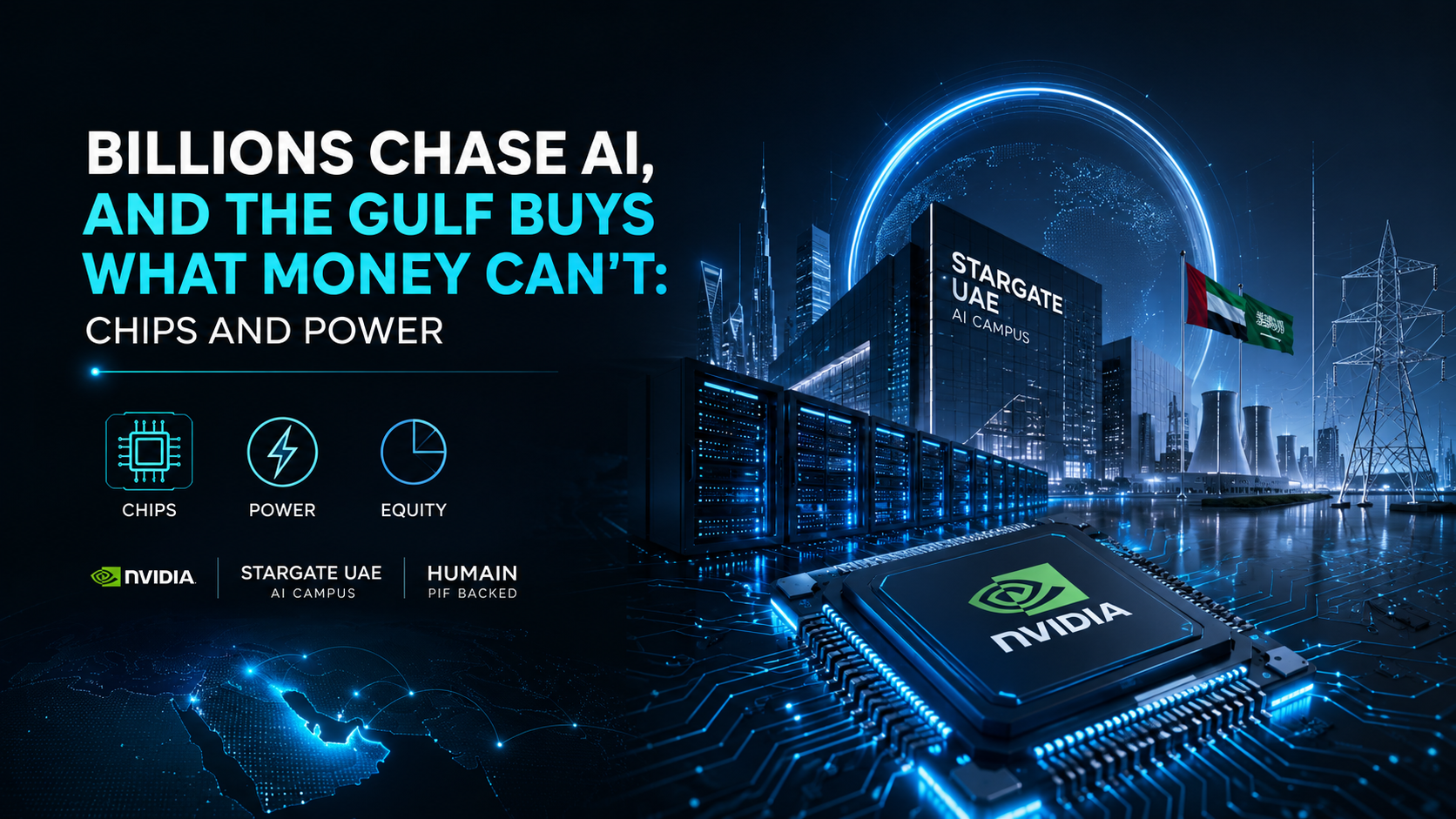
Billions Chase AI, and the Gulf Buys What Money Can't: Chips and Power
AI Investment12 min readJuly 7, 2026

Billions Chase AI, and the Gulf Buys What Money Can't: Chips and Power

In the first half of 2026 alone, investors poured about $510 billion into startups, most of it into a handful of AI labs. But money is no longer the scarcest currency. We unpack how the race shifted to chips, megawatts and equity, and how Saudi Arabia and the UAE are buying their way into the cycle through Nvidia chips, the Stargate UAE campus and PIF-backed HUMAIN.

01

Money Is No Longer the Problem

In the first half of 2026 alone, investors around the world poured roughly $510 billion into startups, a figure that already tops the $440 billion invested across the whole of 2025, according to global funding trackers. The number is striking, but where it went matters more. Most of it flowed into artificial intelligence, and specifically into a small cluster of labs building the largest models. This is not a passing boom in Silicon Valley. It is a redrawing of the tech capital map, and the Gulf has decided not to watch from the sidelines.

The irony is that money is not the constraint this cycle. The sovereign wealth funds of Saudi Arabia and the UAE hold liquidity that most countries can only envy. The real constraint is that the most valuable things in AI can no longer be bought with cash alone. Nvidia's most advanced chips sit behind strict US export controls, the electricity that runs data centers is measured in gigawatts and is genuinely scarce, and equity in labs like OpenAI and Anthropic is all but closed to newcomers. So the race has shifted from "how much money do you have" to "what have you been permitted to buy with it." That is exactly where Riyadh and Abu Dhabi have positioned themselves.

In this analysis I want to connect three scenes that look separate: the concentration of global capital in a handful of companies, the Gulf's race for chips and megawatts, and the real user demand showing up in AI apps. When you put them side by side, a sharper picture emerges of what all of this means for any business operating in the region today, not a decade from now.

02

Four Companies Swallowed Two-Thirds of the Money

Four Companies Swallowed Two-Thirds of the Money

To grasp the concentration, look at the first quarter of 2026. Out of $300 billion in global venture funding, AI captured $242 billion, eighty percent of everything invested, according to Crunchbase data. But the deeper story sits inside that number. Just four companies, OpenAI at $122 billion, Anthropic at $30 billion, xAI at $20 billion, and Waymo at $16 billion, together raised $188 billion, sixty-five percent of the entire quarter.

That pattern says something important about the shape of the market. Foundational AI is no longer a game a thousand small players can enter. It has become an industry that needs nation-scale capital to build a competitive model. When training a single generation of models costs tens of billions, the companies able to raise that much can be counted on one hand, and whoever controls the base model controls a large slice of the value chain built on top of it.

The practical lesson for any investor or founder in the region is that the contest to build a general foundation model is essentially settled in favor of those already there. The real value available today does not lie in repeating what OpenAI did. It lies in building on top of these models with solutions that serve a specific local context and a specific sector, where the doors are still open and the competition is still fair.

03

Why Compute Became the Real Currency

Why Compute Became the Real Currency

When we say money is not the constraint, the actual constraint comes down to two things: chips and electricity. Training and running large models demand tens of thousands of advanced graphics processors, and the best known today are Nvidia's Blackwell family. These chips are not a commodity you buy freely on the open market. The United States imposes export controls that decide who receives them, in what quantities, and under what security conditions. Acquiring the chip has become a geopolitical decision as much as a commercial one.

The second constraint is more physical: power. A modern AI data center draws energy measured in hundreds of megawatts, and the largest campuses plan in gigawatts. That power cannot be conjured overnight. It needs transmission networks, generation plants, cooling, land, and permits. This is why countries with abundant cheap power and open land now hold a genuine advantage in this race, and the Gulf is one of the clearest examples.

Here the logic of Saudi and Emirati moves comes into focus. Both countries are not merely buying hardware. They are buying a position in a scarce supply chain: a share of the chips cleared for export, the ability to generate the power to run them, and partnerships with those who own the models and the operational know-how. Whoever assembles all three owns infrastructure that others cannot quickly replicate.

04

The Gulf's First Move: Chips

The Gulf's First Move: Chips

On November 20, 2025, the US Commerce Department's Bureau of Industry and Security approved the export of up to 35,000 of Nvidia's advanced GB300 chips to each of the UAE's G42 and Saudi Arabia's HUMAIN, seventy thousand chips combined, according to specialist Middle East AI news outlets. The approval was not unconditional. It came tied to strict security and reporting requirements that both companies must meet.

The significance of this news is not the count alone but what it signals. Two Gulf firms receiving this volume of the newest AI chips means Washington now treats Riyadh and Abu Dhabi as trusted partners in the global compute system, not merely as customers. The approval coincided with the Saudi Crown Prince's visit to Washington and the signing of a US-Saudi Strategic AI Partnership, amid reports of roughly $40 billion in Saudi AI deals.

But chips are a double-edged tool. Relying on a single supplier subject to another country's controls means any shift in US policy could upend the math. That is why Gulf states are not content to buy chips alone. They are working to build generation capacity and data-center infrastructure that make them a party hard to bypass, rather than a consumer at the end of the chain.

05

The Second Move: Megawatts

The Second Move: Megawatts

Chips without electricity are silent metal. So the larger share of Gulf spending is heading toward power and data centers. The headline project is Stargate UAE in Abu Dhabi, a full one-gigawatt cluster described as the largest AI campus outside the United States, built by a partnership that includes G42, OpenAI, Oracle, Nvidia, Cisco, and SoftBank. The first 200 megawatts are planned to go live during 2026, inside a broader campus targeting five gigawatts.

The company's updates carry a dose of realism worth noticing. G42 confirmed that work is progressing quickly on the first 200-megawatt phase, expected to complete in 2026, but a spokesperson clarified that the rest of the one-gigawatt cluster, and the wider five-gigawatt campus, do not yet have confirmed completion timelines. That transparency is useful. It separates what is genuinely under construction from what remains a declared ambition.

On the Saudi side, PIF-backed HUMAIN announced in January 2026 a financing agreement of up to $1.2 billion from Saudi Arabia's National Infrastructure Fund, to develop as much as 250 megawatts of data-center capacity serving its local, regional, and global customers. The agreement is still non-binding, a detail that reminds us many of the headline figures in this sector remain at the stage of intent and framework, not full execution.

06

HUMAIN and PIF: Saudi Arabia's Bet

HUMAIN and PIF: Saudi Arabia's Bet

HUMAIN is not merely a data-center operator. It is an arm designed to be Saudi Arabia's national AI platform, under the umbrella of the Public Investment Fund. The logic is clear. Rather than renting compute from foreign providers and staying captive to their pricing and terms, the Kingdom builds its own capacity on its own soil and under its own sovereignty, then sells the surplus to customers across the region and the world.

This positioning fits the logic of Vision 2030 and its drive to move the economy away from oil dependence toward new sectors. Compute is an exportable commodity much like oil, but it attaches to a higher value chain: the data, the models, and the services built on top of it. When a state owns the data centers, it also owns a negotiating position with the companies that want to serve the Gulf market while complying with local data-sovereignty rules.

Still, the bet carries real questions. Building capacity is one thing. Filling it with profitable demand is another. A data center of hundreds of megawatts needs customers paying to run it around the clock, or the strategic asset turns into an operational burden. So the success of HUMAIN's bet will not be measured by announced megawatts. It will be measured by its ability to attract real workloads from enterprises, governments, and startups that find more value in local capacity than in what the global giants offer.

07

The Demand Signal: Where the Money Actually Lands

The Demand Signal: Where the Money Actually Lands

All this infrastructure spending assumes real demand to justify it, and the numbers coming out of the app world confirm the demand is there and accelerating. According to Sensor Tower's State of Mobile report, consumers worldwide spent about $85 billion on apps in 2025, a 21 percent rise on the prior year, with generative AI the standout driver of that growth.

The detail is clearer than the total. In-app purchase revenue in generative AI apps tripled to top $5 billion in 2025, and downloads of those apps doubled to 3.8 billion. ChatGPT alone generated $3.4 billion in in-app purchase revenue. As for time spent, users logged 48 billion hours inside generative AI apps in 2025, which is 3.6 times the 2024 level and ten times where it stood in 2023.

These numbers carry two messages for any company in the region. The first is that user behavior has genuinely shifted. People now pay for AI services rather than just trying them. The second is that the market concentrates at the app layer too, since OpenAI and DeepSeek alone captured nearly half of global AI app downloads, up from twenty-one percent in 2024. The remaining opportunity for local players is not to compete with them head-on, but to serve needs, markets, and languages the giants do not prioritize enough.

08

Agentic AI Crosses Into Production

Agentic AI Crosses Into Production

Alongside consumer apps, agentic AI, meaning systems able to carry out multi-step tasks with autonomy, is moving from demos into live operation. Specialist reports in 2026 indicate that around seventy-two percent of enterprises now run agentic AI solutions in production, with a clear caveat about a persistent gap in governance and controls.

That gap deserves a pause. When an automated system is granted authority to make decisions and take actions without a human in the loop at every step, questions of accountability, auditing, and security become far more pressing. An enterprise deploying an agent that handles customer data or executes financial transactions needs clear logs, precisely scoped permissions, and mechanisms for human intervention when needed. Speed of deployment without sound governance is a recipe for problems that are hard to undo later.

For Gulf companies, this opens a practical door. Demand is growing for agentic AI solutions designed for the local context and compliant with regulatory and data-sovereignty requirements. The value here is not owning the biggest model. It is engineering the solution carefully around a real business process, with controls that make it trustworthy in a serious enterprise environment.

09

The Bubble Question We Can't Ignore

The Bubble Question We Can't Ignore

No honest analysis is complete without asking the hard question: is all of this a bubble? The scale of the numbers invites caution. H1 2026 funding of $510 billion exceeded the whole of 2025, and OpenAI and Anthropic alone captured $217 billion, forty-three percent of first-half funding. When Anthropic is valued at around $965 billion, and a fund like Menlo Ventures sees its roughly $1 billion investment there rise to $14 billion, the signs of exuberance become visible.

On the other side of the equation, less optimistic economic signals appear. The US economy added just 57,000 jobs in June 2026 against expectations near 185,000, and with 142,000 tech layoffs since the start of the year, roughly 88,000 of them were attributed to AI by one estimate. It is a picture hard to ignore: enormous capital flowing to the top of the value chain while part of the labor market feels pressure at the bottom.

The balanced stance is to distinguish two layers. The layer of speculation on lab valuations could face a painful correction if revenue fails to catch up with expectations. The underlying layer, meaning compute, power, and data, looks more like durable infrastructure that will be used regardless of who wins the model race. The Gulf's bet on that underlying layer specifically is more conservative than it first appears, because it buys an asset that stays useful across most scenarios.

10

What This Means for a Business in the Gulf Today

After all these numbers, the practical question remains: what should a mid-sized company or a startup in the region do with this picture? The first thing to grasp is that competing to build a general foundation model is a losing game for anyone without tens of billions. The real value available sits at the application layer, where you can build solutions that serve a specific business process, sector, or local market in its own language and rules, on top of the ready models the giants provide.

Second, the localization of compute in the Gulf hands local companies a practical edge worth investing in. As data centers like Stargate UAE and HUMAIN's Saudi infrastructure mature, running AI workloads inside the region will get easier, with clearer compliance with the data-sovereignty rules regulators impose. A company that builds expertise today in deploying solutions on local infrastructure will be better placed tomorrow.

Third, the demand signal is clear: users and enterprises genuinely pay for real AI value, not for the novelty. The company that ties every project to a measurable outcome, such as a faster response, a lower cost, or a sharper decision, is the one that turns this wave into sustainable growth rather than merely keeping pace with the noise. The opportunity is real, but it rewards those who build with discipline and measure impact, not those who chase headlines.

11

References

1. Global startup funding hits record $510B in H1 2026 — www.masternodeai.com/en/news/global-startup-funding-record-510b-h1-2026-ai-boom

2. Q1 2026 venture funding: $300B, AI takes 80% — Crunchbase — news.crunchbase.com/venture/record-breaking-funding-ai-global-q1-2026

3. US approves up to 70,000 Nvidia chips for G42 and HUMAIN — Middle East AI News — www.middleeastainews.com/p/us-approves-up-to-70000-advanced

4. PIF-backed HUMAIN secures up to $1.2bn to expand AI infrastructure — Arab News — www.arabnews.com/node/2630217/business-economy

5. Introducing Stargate UAE — OpenAI — openai.com/index/introducing-stargate-uae

6. Stargate UAE: first phase of 200MW to complete by 2026 — Gulf News — gulfnews.com/business/markets/stargate-uae-first-phase-of-200mw-to-complete-by-2026-1.500310364

7. Consumers spent more on apps than games in 2025, driven by AI — TechCrunch — techcrunch.com/2026/01/21/consumers-spent-more-on-mobile-apps-than-games-in-2025-driven-by-ai-app-adoption

8. Agentic AI enterprise adoption 2026 and the governance gap — agenticaiinstitute.org/agentic-ai-enterprise-adoption-2026-governance-gap

9. Anthropic backer Menlo Ventures lands $3 billion, largest-ever fund — Bloomberg — www.bloomberg.com/news/articles/2026-06-23/anthropic-backer-menlo-ventures-lands-3-billion-in-its-largest-ever-haul

10. Employment Situation — June 2026 (57,000 payrolls) — US Bureau of Labor Statistics — www.bls.gov/news.release/archives/empsit_07022026.htm

// Want to apply this?

Let's discuss how this applies to your business.

A senior engineer reviews every inquiry and responds within one business day.

Start a Conversation